Henderson, NV
.png)
What Henderson is actually like
Henderson began in 1941 as a federal wartime project. The U.S. War Department picked the site -- inland, shielded by mountain ranges, and positioned roughly halfway between the Los Angeles-Salt Lake City rail line and Hoover Dam's power -- for Basic Magnesium, Inc. (BMI), a plant built to process magnesium ore into material for aircraft parts and incendiary munitions casings. Construction started in September 1941 and the plant opened in February 1942, drawing about 15,000 workers from around the country and, at peak, turning out roughly a quarter of the nation's magnesium supply. The surrounding company town, first called the Basic Townsite, was renamed Henderson in 1944 after former Nevada U.S. Senator Charles B. Henderson. When the war ended and magnesium production wound down, the town nearly emptied out; in 1946 the Nevada Legislature authorized the state's Colorado River Commission to buy the idle industrial plants rather than let the site go to surplus, which kept the town alive long enough to incorporate as its own city on April 16, 1953, with an initial population of about 7,410 and Dr. Jim French as its first mayor.
Henderson has since grown into Nevada's second-largest city. The 2020 Census counted 317,610 residents; the city's own current figures put the population at roughly 359,000 to 369,000 today, spread across about 107 square miles of the southeast valley. It's a fully independent municipality with its own police department, municipal water utility, and elected mayor and city council -- distinct from the City of Las Vegas, even though the two are effectively contiguous inside the Las Vegas-Henderson-Paradise metro area, which took its middle name from Henderson. Much of that growth happened through a series of large master-planned communities built out over decades, starting with Green Valley in 1979 and followed later by Anthem, Seven Hills, Inspirada, Cadence, and Lake Las Vegas. Green Valley and Anthem are covered as their own separate guides on this site; this page covers Henderson's city-level identity, history, and downtown rather than duplicating those neighborhood-level profiles.
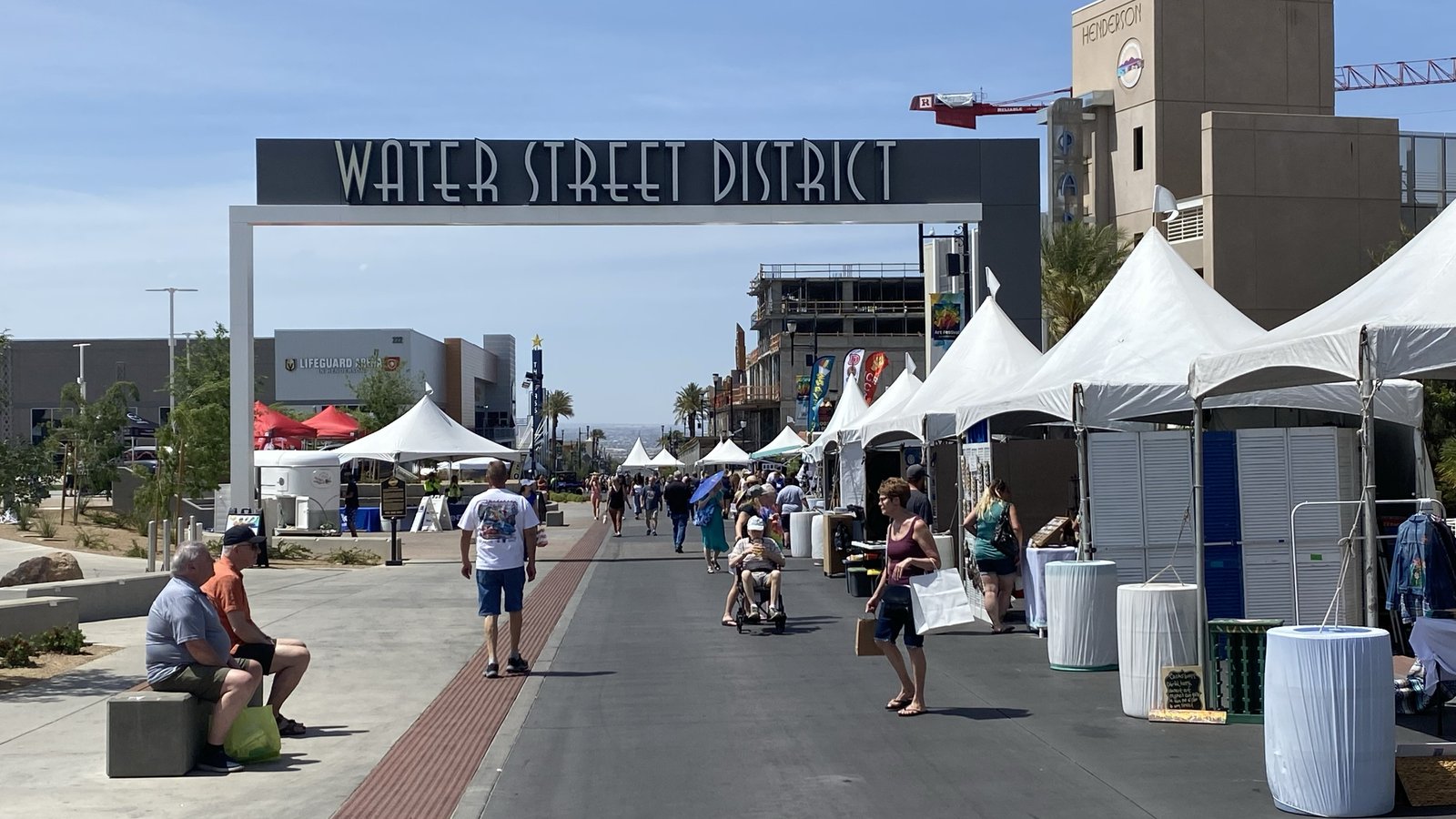
The city's original commercial core survives today as the Water Street District, a roughly one-mile stretch of South Water Street between Ocean Avenue and Lake Mead Parkway that traces its name back to the water main built in 1941 to supply the BMI plant. The city formally branded and began redeveloping the area starting in 2002 (trademarking the 'Water Street District' name in 2014) after decades of retail decline, and it now anchors Henderson City Hall (opened 1989), the Water Street Plaza outdoor event space with its amphitheater and splash pad, small legacy casinos like The Pass (formerly the Eldorado, operating on that site since 1962) and the Rainbow Club (since 1967), and newer mixed-use and hotel development, including the Atwell Suites hotel that opened in 2024. It's still a modest, low-rise downtown by national standards, but it functions as Henderson's civic and cultural center in a way none of the city's newer master-planned areas do.
Home values in Henderson
Zillow's Home Value Index put the typical Henderson home value at $485,484 as of July 31, 2026, down 2.5% year-over-year.
See what makes Las Vegas stand out — verified, named medical, dietary, sports, and other specialty resources you won't find in most metros.
Explore Specialty Resources →Henderson FAQ
Is Henderson part of Las Vegas, or its own city?
Its own city. Henderson is a separately incorporated municipality with its own mayor, city council, police department, and water utility -- it isn't a Las Vegas neighborhood, even though the two cities are physically contiguous and share the same metro area. Henderson is Nevada's second-largest city after Las Vegas itself.
What was Henderson before it was a city?
A World War II company town. The federal government built the Basic Magnesium, Inc. plant here starting in 1941 to process magnesium for aircraft parts and munitions; the surrounding settlement, first called the Basic Townsite, was renamed Henderson in 1944 after former Nevada Senator Charles B. Henderson and incorporated as a city in 1953 once the state stepped in to keep the town from dissolving after the war.
What is the Water Street District?
Henderson's original downtown -- a roughly one-mile stretch of South Water Street anchored by City Hall, the outdoor Water Street Plaza event space, a handful of small legacy casinos dating to the 1960s, and a wave of newer restaurants, apartments, and hotel development. The city has been actively redeveloping it since the early 2000s.
Whatever happened to Henderson Pavilion?
It was demolished in 2020. The outdoor amphitheater that operated under that name is no longer a functioning venue; Henderson's live-event and hockey scene now centers on Lee's Family Forum, a 6,000-seat indoor arena (opened as the Dollar Loan Center and renamed in 2024) that hosts the Henderson Silver Knights AHL team, along with the nearby America First Center practice facility that opened in 2020.
How far is Henderson from the Las Vegas Strip?
About 16 miles from central Henderson to the Strip, typically a 25-to-35-minute drive via I-215, I-515/US-93-95, or Boulder Highway depending on which part of the city you're starting from and the time of day.
What hospitals serve Henderson?
St. Rose Dominican Hospital's Siena campus (one of the city's largest employers) and Henderson Hospital both operate within city limits -- which is closer depends on which part of the city you're in.