Midtown & Automobile Alley, Oklahoma City, OK
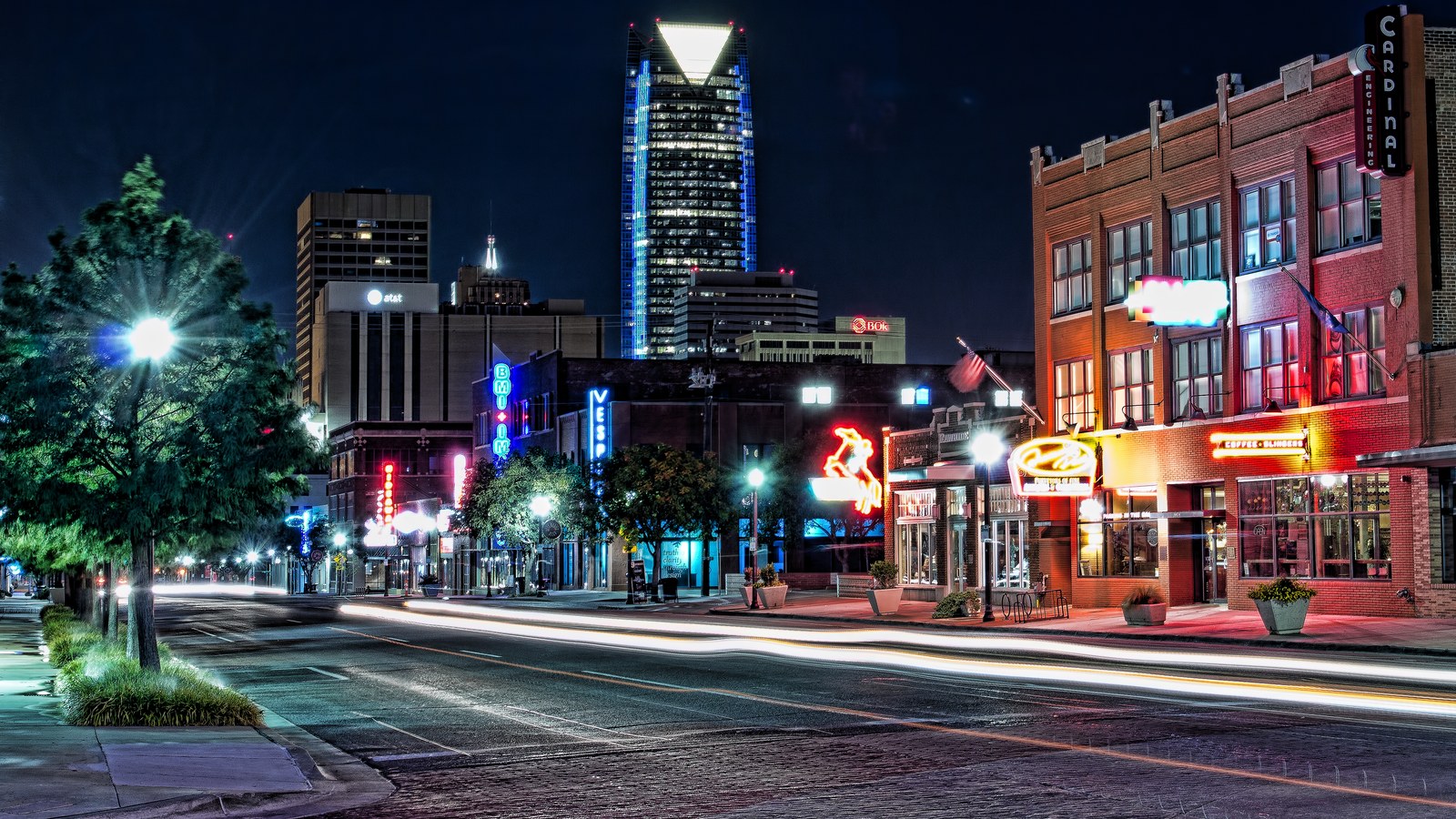

What Midtown & Automobile Alley is actually like
Automobile Alley formed in the 1920s along Broadway between NW 4th and NW 13th, and it dominated the state's car market: the Motor Car Dealers Association reported in 1923 that nine of every ten cars sold in Oklahoma were transactions that started along that stretch, with showrooms for Buick, Chevrolet, Cadillac, Pontiac, Packard, and Pierce Arrow among others. For several decades the district held more than two-thirds of the city's car dealerships (Wikipedia). Midtown, the roughly 387-acre district immediately west and north, carried its own parallel identity as a medical district anchored by St. Anthony's Hospital, the city's oldest and largest, along with smaller residential pockets like the Cottage District.
Both districts declined through the 1970s and 1980s along with the rest of the inner city, and revitalization began in the mid-1990s, when former showrooms and storefronts were converted into residential lofts, galleries, and office space alongside new streetscape work. The 2000s brought sit-down dining -- Colcord Oyster Bar, Red PrimeSteak -- and the pace picked up further after 2015, with Broadway 10 Bar & Chop House and Sidecar Barley Wine Bar opening that year and the Metropolitan apartment complex following in 2016. The district's original identity hasn't entirely vanished: Mercedes-Benz relocated from Broadway to Edmond in 2018 and Volvo followed to a suburban lot in 2019, but Tesla opened a showroom and repair facility in the vacated Volvo building in 2020 -- an EV dealership succeeding a traditional one in the same storefronts where the district's whole identity began (Wikipedia).
Midtown counted an estimated 3,501 residents as of this research, small for a district this central but consistent with a neighborhood still filling in with infill housing rather than one built out as primarily residential from the start (Wikipedia). The OKC Streetcar's Midtown stop, part of the free 4.8-mile downtown loop, puts Bricktown and the Central Business District within a car-free ride, and the district's restaurant density -- concentrated along 10th Street and Broadway -- is dense enough now that Automobile Alley and Midtown are routinely treated as one dining destination rather than two separate ones.
Home values in Midtown & Automobile Alley
Redfin's median sale price for ZIP 73103, covering Midtown and Automobile Alley, was $448,806 over the three months ending August 2026, up 32.0% year-over-year -- among the steepest appreciation rates of any Oklahoma City district researched for this guide, consistent with a small, historic-infill housing stock absorbing sustained loft and townhome demand (Redfin). A median sale price reflects only homes that actually changed hands in that window, not an index of the full housing stock the way Zillow's ZHVI is, so treat it as a directional, not one-to-one comparable, figure against ZHVI-based numbers elsewhere in this metro. Oklahoma's tax structure is genuinely different from the no-income-tax states this site has built in recently: the state levies a personal income tax with three brackets topping out at 4.5% (Tax Foundation), on top of which Oklahoma City's own combined sales tax runs 8.625% (4.5% state plus 4.125% city) (Avalara). Property taxes run the other direction: Oklahoma's statewide average effective property tax rate is 0.80% (26th-highest nationally), though Oklahoma County itself runs a bit above that state average at roughly 0.97%. The state's homestead exemption is modest by design -- a flat $1,000 reduction in a primary residence's assessed fair cash value, not a percentage or dollar-amount cap like Florida's -- with a separate, larger assessed-value freeze available to homeowners 65 or older or with a qualifying disability and household income under $25,000 (PropertyTaxByState.com). That risk shows up directly in insurance costs: Oklahoma homeowners insurance is projected to average around $5,858 a year in 2026, nearly double the roughly $3,057 national average, making Oklahoma the second most expensive state for homeowners insurance despite having no hurricane coastline at all. Hail, not tornado wind directly, is the bigger day-to-day claims driver -- Oklahoma saw 767 hailstorms in 2024, third-most nationally, and each one can generate roof claims across an entire metro area at once -- and the state's homeowners insurance rates rose 24% in 2025 alone as carriers priced that in (Live Insurance News).
Getting around
Midtown and Automobile Alley's restaurant-dense blocks along Broadway and 10th Street are walkable on their own terms, and the free OKC Streetcar's Midtown stop connects directly to Bricktown and downtown without a car. Oklahoma City's citywide Walk Score of 34 is still the honest baseline for errands beyond that walkable core and streetcar line -- a car remains standard for most trips outside the immediate district.
Midtown & Automobile Alley FAQ
Is Midtown/Automobile Alley walkable?
There's no separate Walk Score page for the district, but its restaurant-dense blocks along Broadway and 10th Street are walkable on their own terms, and the free OKC Streetcar's Midtown stop connects it to Bricktown and downtown without a car -- a real step up from Oklahoma City's citywide Walk Score of 34.
Why is it called Automobile Alley if there aren't many car dealerships left?
In the 1920s, nine of every ten cars sold in Oklahoma passed through dealerships on this stretch of Broadway. Most of those dealers left for suburban lots by 2019, but the name and the historic dealership buildings -- now lofts, galleries, and restaurants -- stuck, and a Tesla showroom now occupies the former Volvo building.
Does Midtown/Automobile Alley flood?
No -- the district sits on higher ground well north of the Oklahoma River's channelized path, so direct river flood exposure is minimal. The more relevant severe-weather risk here, as across the metro, is tornado season, which runs roughly April through June.
What's the SSM Health St. Anthony Hospital connection to this neighborhood?
St. Anthony's Hospital, Oklahoma City's oldest and largest, has anchored Midtown since before the district had its current name, and it still sits inside the district today at 1000 N Lee Ave. -- a rare case of a major hospital being a true walk-to landmark rather than a several-mile drive.
How much have home prices risen here?
Redfin's median sale price for the ZIP covering Midtown and Automobile Alley was $448,806 over the three months ending August 2026, up 32.0% year-over-year -- among the steepest appreciation rates researched across Oklahoma City's core districts.
Who lives in Midtown/Automobile Alley?
The district counted an estimated 3,501 residents at the time of this research, small for its central location -- a reflection of a neighborhood still filling in with infill lofts and townhomes rather than one built out as primarily residential from the start.
Nearby alternatives*We're not ranking these — every place has real trade-offs, and which ones matter is up to you.
Bricktown Downtown
A five-minute drive or a free streetcar ride south -- the metro's civic and entertainment anchor, with Paycom Center, the Bricktown Canal, and Scissortail Park.
Plaza Paseo Asian District
A couple of miles north via Classen or Walker -- OKC's arts corridor, with lower home prices and a slower, more gallery-and-restaurant pace than Automobile Alley's dealership-row density.
Uptown 23Rd Western Avenue
A short drive north -- NW 23rd Street and Western Avenue's shopping and dining strips, just south of the separate Nichols Hills suburb.
See what makes Oklahoma City stand out — verified, named medical, dietary, sports, and other specialty resources you won't find in most metros.
Explore Specialty Resources →