Folly Beach, SC
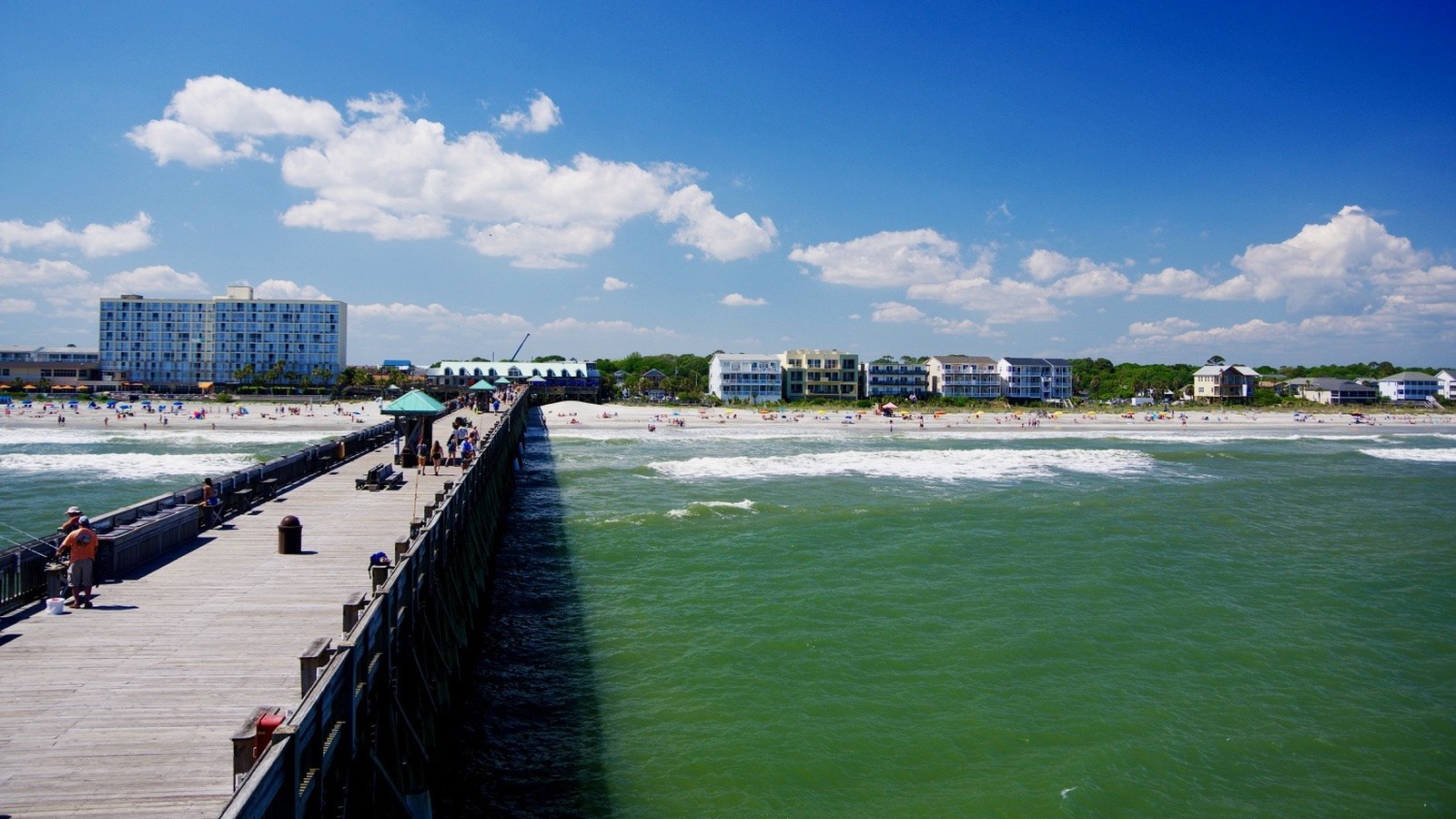

What Folly Beach is actually like
The earliest documented reference to the island dates to 1696, when it was granted by the British Crown under the name "Coffin Island." The name that stuck instead, "Folly," comes from an Old English term for dense foliage, a nod to the overgrown, jungle-like vegetation early visitors found there; Union troops later used the island's ridges and dunes as staging ground for the siege of nearby Fort Sumter and Charleston Harbor during the Civil War (FollyBeach.com). Folly turned into a beach resort in the early 1900s -- a pavilion went up in the 1920s, and the 1930s brought the Atlantic Pavilion, a boardwalk, a pier, and the Oceanfront Hotel, the boom that earned the island its lasting nickname, "the Edge of America" (FollyBeach.com). That same decade, in 1933, author DuBose Heyward and his wife Dorothy built a summer cottage at what's now 712 West Ashley Avenue; the following summer they hosted composer George Gershwin there while the three finished the opera Porgy and Bess, with Gershwin drawing on Gullah spirituals he heard at a church on nearby James Island. The opera debuted on Broadway in 1935, and the "Porgy House" still stands today (Visit Folly Beach, FollyBeach.com).
Folly Beach incorporated as its own town in 1938 and became a city in 1973 -- a separate municipal government from Charleston, not a Charleston neighborhood (Wikipedia). The event that most shaped the island's modern building stock and its whole relationship to risk was Hurricane Hugo, which came ashore near Folly Beach as a Category 4 storm just after midnight on September 22, 1989; a roughly 12-foot storm surge destroyed nearly all of the island's oceanfront single-family homes (FollyBeach.com). Because Charleston Harbor's federally built jetties block the sand that would otherwise drift naturally down to Folly, the beach itself now depends on artificial renourishment -- the Army Corps of Engineers has spent roughly $77 million on five renourishment projects since the 1990s, plus a separate $27 million emergency renourishment (about 90,000 dump-truck loads of sand) after storm damage in early 2024 (Post and Courier).
The 2020 Census counted 2,078 year-round residents on Folly Beach, a number that swells considerably every summer with vacation renters (Wikipedia). Two of that small population's biggest current fights are both about who gets to live and rent here: the city's FEMA Community Rating System score has climbed from Class 7 to Class 4, cutting flood-insurance premiums by a combined $1,041,103 a year across policyholders (NOAA), while a voter-approved 800-license cap on investment short-term rentals -- passed by a 655-577 referendum vote in February 2024 -- was still being fought over as of mid-2026, with more than 950 licenses already active against the 800-license ceiling (Live 5 News, Post and Courier).
Home values in Folly Beach
Zillow's own typical home value (ZHVI) for Folly Beach was $1,079,890 as of June 30, 2026, down 1.2% year-over-year, with a median list price of $1,075,833 across 89 active listings that month (Zillow). Redfin's median SOLD price for the same window was $1,024,487, up 25.7% year-over-year, with homes taking a median 103 days to sell -- 18 days faster than a year earlier (Redfin); the gap between Zillow's list-driven figure and Redfin's closed-sale figure is typical of a small, thin market where a handful of sales can move the median. South Carolina taxes an owner-occupied primary residence at a 4% assessment ratio and everything else -- second homes, rentals, most LLC-owned property -- at 6% (Nat Wallen); on a barrier island where a meaningful share of the housing stock is non-owner-occupied investment or short-term-rental property, that 6% default rate is a bigger factor in the real math here than in a typical suburb, and a new owner has to file for the legal-residence exemption to get to 4%. That assessed value is then multiplied by the local millage rate rather than a flat statewide percentage; South Carolina's statewide average effective property tax rate on owner-occupied housing is 0.49%, alongside a 6.00% state sales tax (7.49% average combined with local option taxes) and a graduated income tax topping out at 5.21% (Tax Foundation). Dominion Energy is the electric utility on the island (WCBD); unlike most of the metro, Folly Beach runs its own municipal water and sewer system rather than buying service from Charleston Water System, serving roughly 3,852 people with purchased surface water (City of Folly Beach, EWG).
Evenings and weekends
Center Street is the island's compact commercial spine -- a few blocks of surf shops, seafood restaurants, and bars that draw both residents and day-trippers, anchored by the Folly Beach Fishing Pier, rebuilt and reopened in 2023 -- the latest chapter for a pier line on the same stretch of beach that goes back to the 1930s boom and saw an earlier pier burn down in 1977 (FollyBeach.com). The island's surf culture dates to the 1960s, when the first surfboards showed up on Folly's beach breaks, and it remains one of the East Coast's better-known surf spots today (FollyBeach.com). The Porgy House at 712 West Ashley Avenue, where DuBose Heyward and George Gershwin worked on Porgy and Bess in 1934, still stands as a private residence and occasional tour site, a rare piece of American musical-theater history sitting on an ordinary residential block (Visit Folly Beach).
Getting around
Folly Beach doesn't publish a single official citywide Walk Score the way peninsula Charleston does; the blocks nearest Center Street and the beach are flat and walkable, but Folly Road (SC-171) is the only road connecting the island to the mainland, so most residents keep a car. Downtown Charleston sits roughly 12 miles north via the James Island Connector (SC-30) and Folly Road, typically a 20-30 minute drive that stretches longer on summer weekends when beach traffic backs up on the island's single access road (Babies & Beaches). Folly Beach has no hospital of its own; Roper Hospital, a 332-bed, 24-hour-ER facility at 316 Calhoun St in downtown Charleston founded in 1829 as the first community hospital in the Carolinas, is the nearest full-service hospital (Roper St. Francis). Flooding, not distance, is the bigger practical constraint on the island itself: as a barrier island, Folly Beach deals with tidal, rain, and storm flooding on what city officials describe as a weekly basis, and the beach itself depends on the Army Corps of Engineers' ongoing renourishment program rather than natural sand supply, since Charleston Harbor's federal jetties block sand that would otherwise drift south to Folly (NOAA).
Folly Beach FAQ
Is Folly Beach a good place to live?
It depends what you want -- Folly Beach is a small, walkable-scale barrier-island city of 2,078 year-round residents (2020 Census) built around a flat beach grid, but it also carries a real flood and hurricane-exposure story and a capped, contested short-term-rental market that shape both prices and who's actually living next door.
Does Folly Beach flood, and what does that mean for insurance?
Yes -- as a barrier island the city deals with tidal, rain, and storm flooding on a routine basis, but its FEMA Community Rating System score has improved from Class 7 to Class 4, saving flood-insurance policyholders a combined $1,041,103 a year (about $652 per policy, a 30% discount) versus $520,552 a year under the old rating. Confirm the FEMA flood zone for a specific address before buying.
What's the deal with Folly Beach's short-term rental cap?
Voters approved an 800-license cap on investment (non-owner-occupied) short-term rentals in a February 2024 referendum that passed 655-577. More than 950 licenses were already active when the cap took effect, so it will take years of attrition to reach 800, and city council was still debating whether to raise, keep, or eliminate the cap as of mid-2026.
What did Hurricane Hugo do to Folly Beach, and is that risk still real?
Hugo came ashore near Folly Beach as a Category 4 storm just after midnight on September 22, 1989, with a roughly 12-foot storm surge that destroyed nearly all of the island's oceanfront single-family homes. The Army Corps of Engineers has since spent about $77 million on five renourishment projects plus a $27 million emergency renourishment in 2024, because Charleston Harbor's federal jetties block sand that would otherwise replenish Folly's beach naturally.
Is Folly Beach really its own city, separate from Charleston?
Yes -- Folly Beach incorporated as its own town in 1938 and became a city in 1973, entirely separate from the City of Charleston, with its own police, fire department, and municipal water/sewer utility. It sits about 12 miles south of downtown Charleston via Folly Road (SC-171).
Do you need a car on Folly Beach?
Center Street and the blocks nearest the beach are flat and compact enough to walk or bike, and Folly Beach doesn't publish a single citywide Walk Score the way peninsula Charleston does. Most residents still keep a car, since Folly Road (SC-171) is the only route on or off the island and the rest of the metro is a 20-30 minute drive away.
Nearby alternatives*We're not ranking these — every place has real trade-offs, and which ones matter is up to you.
James Island
The mainland stepping-stone between Folly Beach and downtown -- a mix of older ranch-house neighborhoods and newer infill, with its own city government separate from both Folly Beach and Charleston.
Johns Island
Charleston County's largest and fastest-growing island by land area, still mostly rural and agricultural alongside new subdivisions pushing out from the Maybank Highway corridor.
Downtown Charleston
The historic peninsula about 12 miles north -- walkable, flood-studied, and earthquake-studied, with Rainbow Row, the Battery, and King Street.
See what makes Charleston stand out — verified, named medical, dietary, sports, and other specialty resources you won't find in most metros.
Explore Specialty Resources →