Moore, OK
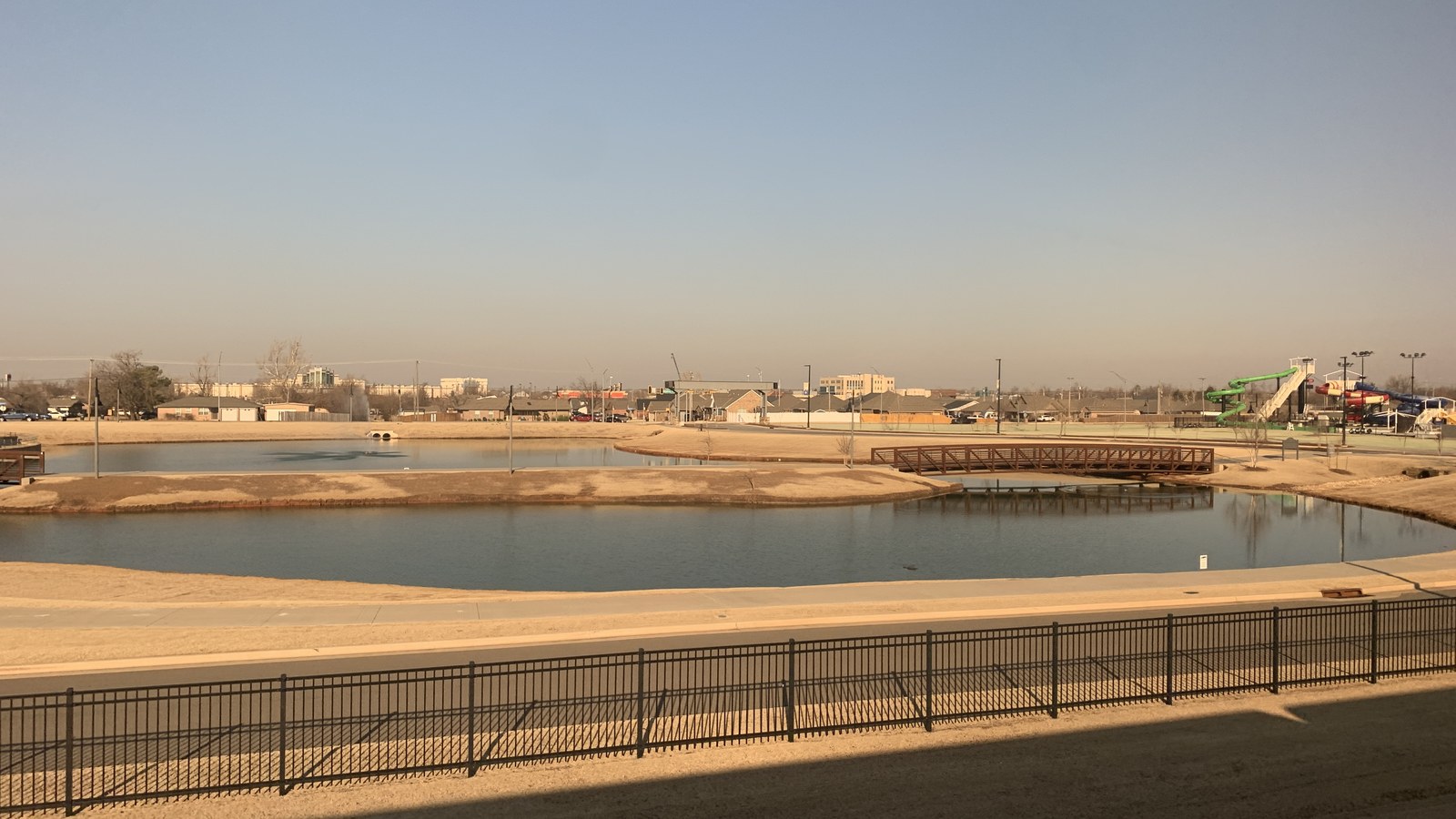

What Moore is actually like
Moore began as a railroad watering stop. The Southern Kansas Railway (later folded into the Atchison, Topeka and Santa Fe) laid track through the site in 1886–87 under the name Verbeck, and the settlement was renamed for Al Moore, a railway employee who, per local history, simply painted his name on a board and nailed it to the boxcar he was living in; the post office opened May 27, 1889, and the town incorporated in 1893 with a hotel, a livery, three general stores, a saloon, a restaurant, and a lumber yard (Oklahoma Historical Society). It stayed a small farm-and-ranch town for seven decades — 942 residents in 1950 — until a 1961 annexation of 21.6 square miles and the postwar pull of nearby Tinker Air Force Base, an Oklahoma City General Motors plant, and the University of Oklahoma turned it into one of the state's fastest-growing cities: population went from 1,783 in 1960 to 18,761 by 1970 and kept climbing through the rest of the century (Oklahoma Historical Society).
No fact defines Moore more than what's hit it from the sky. An F5 tornado tore through the city on May 3, 1999, killing dozens across the OKC metro and recording a wind speed of 321 mph near Bridge Creek — the highest wind speed ever measured on Earth at the time; an F4 followed on May 9, 2003, largely along a similar path (Wikipedia; National Weather Service Norman/Oklahoma City). Then, on May 20, 2013, an EF5 tornado with estimated peak winds of 200–210 mph cut a 13.85-mile, up-to-1.1-mile-wide path directly through the same part of the city, killing 24 people and injuring 212, destroying roughly 1,150 homes, and causing an estimated $2 billion in damage — among the costliest single tornadoes in U.S. history; the National Weather Service credited its roughly 16-minute warning lead time with holding the death toll below what the 1999 storm caused (Wikipedia). The city rewrote its building code the following year — becoming, per Construction Dive's reporting, the first city in the nation to write wind-resistance provisions (continuous structural wood-panel sheathing on exterior and gable-end walls, engineered to a 135-mph design wind speed, roughly EF2 strength) directly into its residential code, at an estimated added cost of about $1 per square foot (Construction Dive). That code does not require an individual storm shelter or safe room in every new home — Moore's city manager said at the time the council had discussed safe rooms only for commercial and multifamily buildings, not a residential mandate, and no such requirement has followed since (StateImpact Oklahoma) — so a shelter here is still a homeowner's own investment: common enough that a real, active local installer market treats Moore as a core customer base, but not something a buyer should assume comes with a house.
Moore's population reached an estimated 63,609 as of July 1, 2025, with a median household income of $80,420 and a 67.9% homeownership rate, both noticeably higher than Norman's (U.S. Census Bureau). Moore Public Schools, which had only two tornado safe rooms districtwide in 2013, had built 24 more across 35 sites within a few years — funded by FEMA grants, insurance payouts, donations, and a $106 million 2015 bond issue — reaching essentially full coverage (KFOR). The city's other lasting export is country singer Toby Keith, who moved to Moore as a kid, graduated from Moore High School in 1979, and later opened a location of his own Toby Keith's I Love This Bar & Grill in the town that raised him (Moore Monthly).
Home values in Moore
Zillow's Home Value Index for Moore was $220,295 as of September 30, 2025, up 2.4% year-over-year — Zillow doesn't refresh every city's page on the same cadence, so this figure runs about ten months older than Norman's (Zillow). The same statewide tax picture applies here as in the rest of Oklahoma: a graduated income tax from 0.50% up to a 4.50% top bracket, and a comparatively low statewide effective property tax rate around 0.79% of owner-occupied home value, with a standard homestead exemption and Cleveland County's assessor setting the specific mill rate for a given address (Tax Foundation). Moore's own post-2013 building code adds a modest, known cost to new construction specifically — the wind-resistance sheathing requirements run an estimated $1 per square foot, per OU civil engineering professor Chris Ramseyer (Construction Dive) — and homeowners insurance here should be shopped with the region's tornado and hail exposure specifically in mind, rather than assuming a quote transfers cleanly from a lower-risk state.
Getting around
There's no way around it: Moore is a car city. A 32 Walk Score and no Transit Score at all mean daily errands, and the commute to a job in OKC or Norman, run through I-35 and a car; the closest thing to public transit is Norman's twice-weekly EMBARK connector to the Social Security office. What Moore does have is a genuinely dense outdoor-siren network and, compared to most American suburbs, an unusually high rate of homes built or retrofitted with private storm shelters — worth asking about specifically when touring a house here.
Moore FAQ
Is Moore a good place to live, given its tornado history?
Many people think so -- Moore's population and home values have both grown since 2013, not shrunk. The city rewrote its building code after the 2013 EF5, schools have rebuilt with dedicated safe rooms, and storm preparedness here is a genuinely normal, unembarrassed part of local culture rather than a red flag. It's a real risk to plan for, not a reason to avoid the city.
Does Moore require storm shelters or safe rooms in new homes?
No. Moore's 2014 building code update requires new homes to meet a 135-mph wind-resistance standard, but it does not mandate an individual storm shelter or safe room in every new house -- that remains the homeowner's own choice and investment, common though it is locally.
What tornadoes has Moore actually been hit by?
Three violent tornadoes since 1999: an F5 on May 3, 1999 (with a nearby wind speed reading of 321 mph, the highest ever recorded on Earth at the time); an F4 on May 9, 2003; and an EF5 on May 20, 2013 that killed 24 people and caused an estimated $2 billion in damage. All three followed largely overlapping paths through the same part of the city.
Is Moore walkable?
No -- Walk Score rates Moore a car-dependent 32, with no meaningful public transit system of its own. Getting anywhere here, including to a job in Oklahoma City or Norman, means driving I-35.
What hospital serves Moore?
Norman Regional Moore, a 24/7 emergency department and outpatient campus on S. Telephone Road, handles emergency and outpatient care but doesn't admit inpatients. The nearest full-service hospital is Norman Regional's main 324-bed campus in Norman, about 10 miles south.
Who is Moore's most famous resident?
Country singer Toby Keith, who moved to Moore as a kid, graduated from Moore High School in 1979, and later opened a location of his own restaurant chain, Toby Keith's I Love This Bar & Grill, in the city.
Nearby alternatives*We're not ranking these — every place has real trade-offs, and which ones matter is up to you.
Norman
About 10 miles south on I-35 -- a larger (roughly 130,900 residents), more expensive college town built around the University of Oklahoma, with a walkable downtown core Moore doesn't have.
Bricktown Downtown
About 10 miles north via I-35 -- Oklahoma City's downtown/entertainment core and the metro's biggest job center, directly up the interstate from Moore.
See what makes Oklahoma City stand out — verified, named medical, dietary, sports, and other specialty resources you won't find in most metros.
Explore Specialty Resources →