South Beach, Miami Beach, FL
.jpg)
What South Beach is actually like
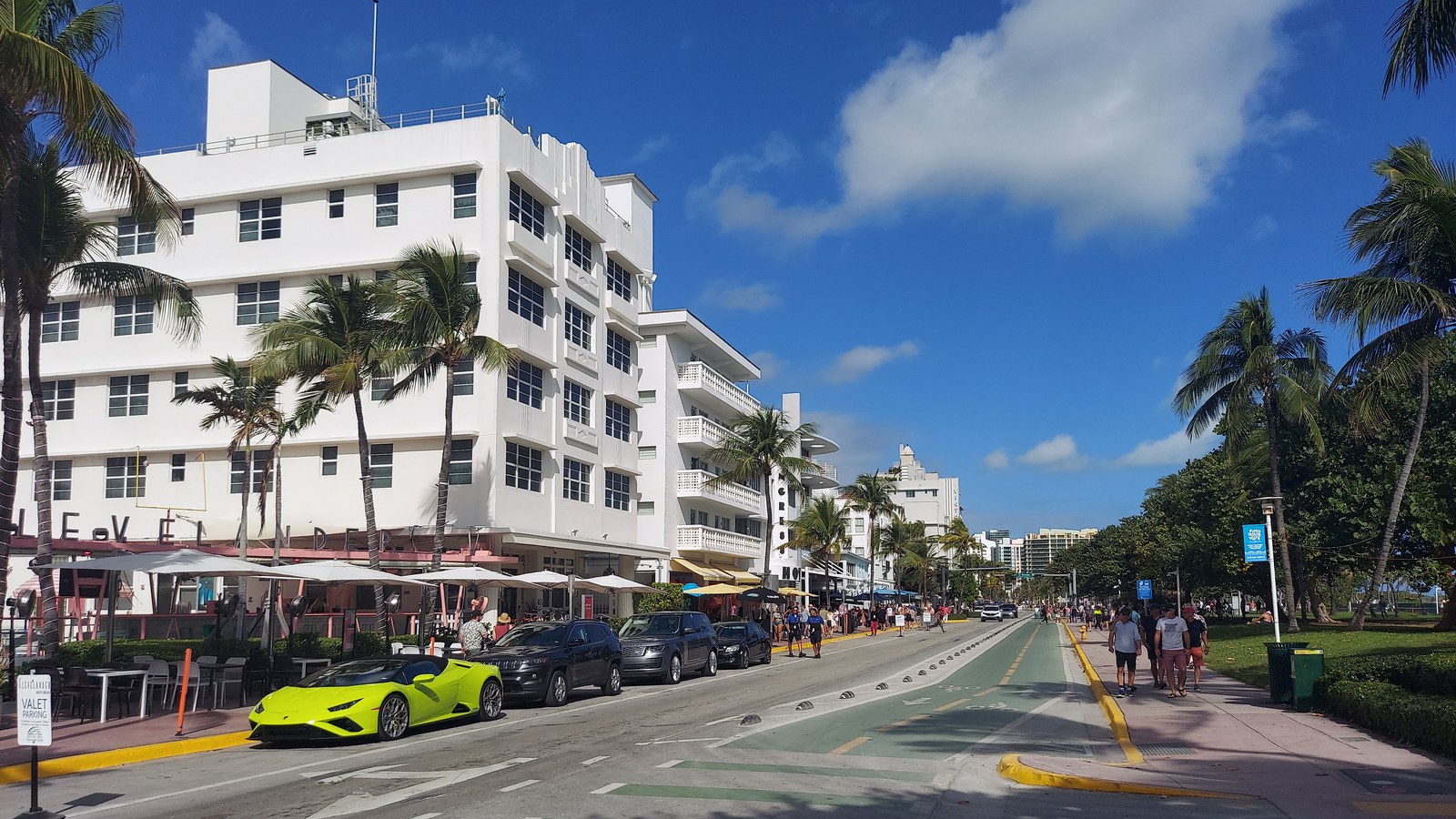
South Beach began as Lummus-family coconut farmland on a barrier-island sandbar until developer Carl G. Fisher arrived in 1913 with money from selling his auto-parts business to Union Carbide and a plan to build a resort city; his $50,000 loan helped John Collins finish the bridge connecting the mainland to the beach that same year, and on March 26, 1915, Fisher, the Lummus brothers, and Collins incorporated the Town of Miami Beach (Source). The 1920s land boom drew wealthy transplants — Harvey Firestone, J.C. Penney, even President Warren G. Harding — though the era also carried an ugly footnote: antisemitic covenants barred Jewish residents from neighborhoods north of Fifth Street into the mid-1920s (Source). The architecture that made the neighborhood famous arrived in the 1930s, when hundreds of small hotels and apartment buildings went up in Art Deco, Streamline Moderne, and Nautical Moderne style — giving South Beach what’s described as the world’s largest collection of Streamline Moderne Art Deco buildings — and by 1940 the town’s population had reached roughly 28,000 (Source).
By the 1950s the boom had faded and South Beach settled into a quiet retirement community of aging hotels and elderly residents, many of them Holocaust survivors; the decades that followed brought real decay and a reputation for drug trafficking that Miami Vice and Scarface later mythologized on screen (Source). The turnaround began with preservationist Barbara Baer Capitman, who co-founded the Miami Design Preservation League in 1977 and fought to save the district — she was known to chain herself to hotels slated for demolition — even as buildings like the Boulevard Hotel fell anyway; her campaign succeeded in 1979, when roughly a square mile of South Beach was listed on the National Register of Historic Places as the Miami Beach Architectural District, the first 20th-century district anywhere in the country to earn that designation (Source). A widely covered 1980 visit by Andy Warhol and, later in the decade, Miami Vice’s pastel-lit backdrops helped pull the fashion industry and international money back in, and developer Thomas Kramer is credited with kicking off the construction boom that carried the neighborhood’s gentrification through the 1990s (Source).
Today South Beach is Miami Beach’s tourism, fashion, and nightlife engine, drawing international visitors to Ocean Drive, Lincoln Road, and events like Art Basel Miami and Miami Beach Pride; the 2010 census counted 39,186 residents in the neighborhood, though more current population figures aren’t clearly published at this sub-city level (Source). Recent development has run mostly toward condo and hotel renovation rather than new towers, since much of the neighborhood sits inside the protected Art Deco Historic District, which limits demolition and new construction; at the same time, South Beach anchors the City of Miami Beach’s broader, well-publicized push into flood-adaptation infrastructure — new stormwater pumps and raised roads — described in the flood-risk section below (Source).
Home values in South Beach
South Beach’s housing stock trades at a real premium even within pricey Miami Beach: Redfin puts the median sale price for the three months ending June 2026 at $1,046,930, up 16.0% year-over-year, though the median price per square foot ($432) actually slipped 4.6% over the same period — a sign the mix of what’s selling is shifting more than broad appreciation is driving the median (Source). Zoomed out, Zillow’s Home Value Index for the wider Miami metro area stood at $580,866 as of August 31, 2026, up 0.8% year-over-year (Source) — useful context, though it blends far cheaper mainland neighborhoods in with beachfront South Beach. Renters, per RentCafe, pay an average of $3,436 a month across Miami Beach as a whole, with studios averaging $2,087, one-bedrooms $2,998, and two-bedrooms $4,310 (Source). Florida’s post-Surfside condo law, SB 4-D, requires condo and co-op associations in buildings three stories or taller to complete a Structural Integrity Reserve Study at least every 10 years (associations formed before July 1, 2022 owed their first by December 31, 2025) and bars waiving reserve funding for big-ticket items it flags — roof, load-bearing structure, plumbing, electrical, waterproofing, and any component over $25,000, among others (Fla. Stat. §718.112(2)(g), §719.106(1)(k)) (Source). That law lands with particular weight in South Beach: a large share of its condo stock is the same pre-1980s Art Deco and Streamline Moderne building fabric that makes the neighborhood a National Register district, meaning buyers and boards here are working through reserve studies and structural reviews on buildings that are, in many cases, 80 to 90 years old — older than the newer high-rise stock common in neighborhoods like Brickell.
Getting around
Miami Beach as a whole carries a Walk Score of 76 (“Very Walkable”), a Transit Score of 51, and a Bike Score of 69 (Source), and South Beach is consistently the most walkable slice of that citywide figure — sub-areas within it, like Flamingo-Lummus (Walk Score 95) and South Pointe (91), rank among the most walkable places in Florida, since daily errands, restaurants, and the beach itself are within a short walk of most South Beach addresses (Source).
South Beach FAQ
Is South Beach walkable?
Yes — it’s one of the most walkable neighborhoods in Florida. Miami Beach citywide carries a Walk Score of 76, but South Beach’s own sub-areas score even higher: Flamingo-Lummus hits 95 and South Pointe hits 91, meaning groceries, restaurants, and the beach are typically a short walk from home (Source).
How much flood and storm-surge risk does South Beach carry?
A real amount — South Beach sits at the tip of a low barrier island, and Miami Beach’s own emergency managers describe the entire city as an evacuation zone (Source). Hurricane Irma triggered mandatory evacuations here in 2017, and the city has since spent roughly $500 million on pumps and raised roads to manage routine tidal flooding on top of hurricane risk (Source).
Does Florida’s new condo inspection law (SB 4-D) matter here?
Probably more than in most Miami neighborhoods. SB 4-D requires Structural Integrity Reserve Studies and bars underfunding major reserve items in condo buildings three stories and up (Source), and South Beach’s housing stock is disproportionately older, pre-1980s Art Deco and Streamline Moderne buildings that have since been converted to condos — exactly the kind of aging structures the law targets. Buyers should ask any condo board directly about reserve-study status and upcoming special assessments.
Do I need a car in South Beach?
Not necessarily for daily life within the neighborhood — it’s dense and walkable, with a free trolley covering the rest of South Beach. But there’s no Metrorail or Metromover station here, so reaching downtown Miami, Brickell, or the airport means a roughly 3.5-mile trip over the MacArthur Causeway by car, rideshare, or Metrobus — and because South Beach is on a barrier island, every one of those trips depends on causeway traffic, which can back up badly at rush hour or during storms (Source).
Is South Beach a good fit for families?
It can work, but it’s honestly not the neighborhood’s core identity — South Beach is built around tourism, nightlife, and the beach, and the Ocean Drive strip in particular skews toward visitors rather than year-round family life. That said, real families do live here: South Pointe Elementary is a strong, well-rated zoned school (Source), and quieter pockets like South Pointe and the residential streets west of Washington Avenue see more long-term residents than the Ocean Drive strip does.
What is there to do in South Beach?
A lot — it’s the reason most visitors come to Miami Beach at all. The Art Deco Historic District’s pastel hotels line Ocean Drive; Lincoln Road Mall is a pedestrian shopping and dining strip; South Pointe Park anchors the southern tip with beach and bay views; the Wolfsonian–FIU museum covers design and propaganda history; and the neighborhood hosts major annual events like Art Basel Miami and Miami Beach Pride (Source).
Nearby alternatives*We're not ranking these — every neighborhood has real trade-offs, and which ones matter is up to you.
Mid-Beach
North along Collins Avenue — a quieter resort corridor built around big mid-century hotels (the Fontainebleau, the Faena) rather than South Beach's dense Art Deco streetscape and nightlife.
Key Biscayne
A separate island south of downtown Miami — lower-rise, far more residential and family-oriented, and reachable only via the Rickenbacker Causeway rather than Miami Beach's own causeways.
See what makes Miami-Fort Lauderdale stand out — verified, named medical, dietary, sports, and other specialty resources you won't find in most metros.
Explore Specialty Resources →