Mid-Beach, Miami Beach, FL
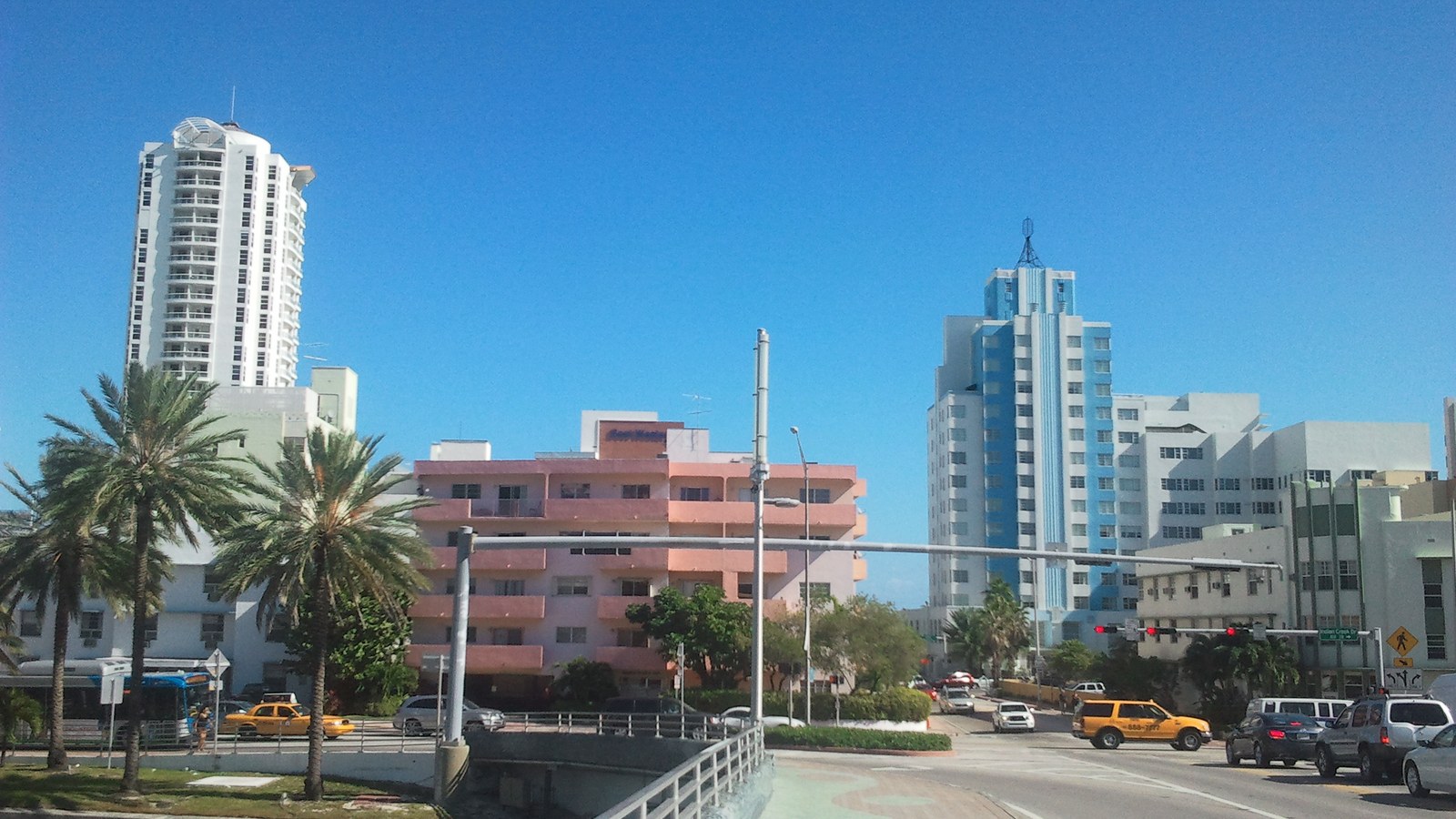

What Mid-Beach is actually like
Mid-Beach’s stretch of Collins Avenue between roughly 44th and 59th Streets was "Millionaire’s Row" by the 1910s and 1920s — some forty oceanfront estates built by Midwestern industrialists such as Yellow Cab founder John D. Hertz and advertising executive Albert Lasker, many designed in Mediterranean Revival style by architects Richard Kiehnel and August Geiger and anchored by the Snowden estate to the south and the exclusive Bath Club to the north (57 Ocean).
That mansion row didn’t survive the postwar boom: by the mid-1950s the estates had been razed for hotels, and in 1954 hotelier Ben Novack opened the Fontainebleau on the former Harvey Firestone estate, designed by architect Morris Lapidus in the swooping, bow-tie-motif style that came to define Miami Modern (MiMo) architecture — followed two years later by Lapidus’s Eden Roc next door (Fontainebleau Miami Beach — Wikipedia; City of Miami Beach). The Fontainebleau was added to the National Register of Historic Places in 2008 after a $1 billion renovation, and its grounds have made it a recurring film location, from Goldfinger to Scarface (Fontainebleau Miami Beach — Wikipedia).
The resort corridor kept reinventing itself into the 2010s: Argentine hotelier Alan Faena redeveloped several blocks around 32nd–36th Streets into the Faena District, anchored by the Faena Hotel Miami Beach, which opened in 2015 with interiors by Baz Luhrmann and Catherine Martin alongside a mix of hotel rooms, condos, and public art (Faena Hotel Miami Beach — Wikipedia). Older hotel-era towers along Collins Avenue have converted into condominiums and condo-hotels over the same period, giving Mid-Beach one of Miami Beach’s heaviest concentrations of resort-adjacent condo stock — a fact that matters directly for the state condo-safety law described below.
Home values in Mid-Beach
Redfin puts Mid-Beach’s median sale price at $794,616 as of August 2026, up 22.2% year-over-year, with homes trading at roughly $591 per square foot (down 3.3% YoY even as the median price climbed, a sign the mix of what’s selling has shifted) (Redfin). Zoomed out to the whole Miami metro, Zillow’s Home Value Index (ZHVI) stood at $580,866 as of Aug 31, 2026, up 0.8% year-over-year (Zillow) — Mid-Beach’s resort-corridor condo towers generally trade above that metro-wide blend. RentCafe doesn’t publish a Mid-Beach-specific rent figure, but its most recent Miami Beach citywide average is $3,436 a month, up 5.33% year-over-year, breaking out to roughly $2,087 for a studio, $2,998 for a one-bedroom, and $4,310 for a two-bedroom (RentCafe); given Mid-Beach’s concentration of newer, resort-branded towers, actual asking rents there likely run above that citywide blend rather than below it.
Florida’s post-Surfside condo law, SB 4-D (2022), matters here because so much of Mid-Beach’s housing stock is exactly the kind of aging beachfront condo and condo-hotel tower the law targets: it requires condo and co-op associations in buildings three stories or taller to complete a Structural Integrity Reserve Study at least every 10 years (associations formed before July 1, 2022 owed their first by December 31, 2025) and bars waiving reserve funding for big-ticket items it flags — roof, load-bearing structure, plumbing, electrical, waterproofing, and any component over $25,000, among others (Fla. Stat. §718.112(2)(g), §719.106(1)(k)) (Florida DBPR).
Getting around
Miami Beach’s 33140 zip code, which covers most of Mid-Beach, posts a Walk Score of 65 ("Somewhat Walkable"), meaning some errands can be done on foot but a car or trolley is still useful for most trips; Walk Score does not publish separate Transit or Bike Score figures for this zip code (Walk Score). In practice that plays out as a corridor of hotel lobbies, poolside cafés, and beachfront paths that are easy to stroll, connected by Collins Avenue traffic that is not especially pedestrian-friendly to cross.
Mid-Beach FAQ
Is Mid-Beach walkable?
Somewhat. The 33140 zip code that covers most of Mid-Beach scores 65 on Walk Score, or "Somewhat Walkable" — you can stroll the beachwalk, hotel districts, and 41st Street corridor on foot, but Collins Avenue itself is wide and car-dominated, and most day-to-day errands still call for a car or the free trolley (Walk Score).
How much flood and storm-surge risk does Mid-Beach face?
Significant. Redfin’s climate data (via First Street Foundation) puts 97% of Mid-Beach properties at severe flood risk and 100% at extreme hurricane wind risk over the next 30 years (Redfin). The city has been raising roads and adding stormwater pumps since 2011, but low-lying streets near Alton Road and Indian Creek still flood in king tides and heavy rain (Miami Beach Rising Above).
Does Florida’s SB 4-D condo inspection law affect buying a condo in Mid-Beach?
For most buyers here, yes. Mid-Beach’s housing stock leans heavily toward older beachfront condo and condo-hotel towers, and SB 4-D requires associations in buildings three stories or taller to complete a Structural Integrity Reserve Study every 10 years and to fund reserves for major systems without waivers (Florida DBPR). Ask any HOA for its most recent reserve study and funding status before buying.
Can I live in Mid-Beach without a car?
It’s workable but not effortless. The free Middle Beach Loop trolley and Metrobus cover the corridor, and much of daily life — beach, dining, hotels — is within walking distance of a resort address, but there’s no rail line, and errands off the main corridor generally mean a car, rideshare, or a longer trolley ride (City of Miami Beach).
Is Mid-Beach good for families?
It’s possible, but Mid-Beach’s identity is built around hotels and resort-branded condo towers rather than family housing stock, and honestly, most of the area skews toward part-time residents, tourists, and adults. Families are better represented in Miami Beach’s quieter residential pockets (North Beach among them); Mid-Beach families do have access to the same M-DCPS schools as the rest of the island.
What is there to do in Mid-Beach?
This is Miami Beach’s resort corridor: the Fontainebleau and Eden Roc for poolside daytime clubs and nightlife, the Faena District for art, dining, and boutique shopping, plus direct beach access up and down Collins Avenue and Mount Sinai Medical Center for the island’s only hospital-level care.
Nearby alternatives*We're not ranking these — every neighborhood has real trade-offs, and which ones matter is up to you.
South Beach
South along Collins Avenue — the Art Deco Historic District, Ocean Drive, and Miami Beach's densest concentration of nightlife and tourism, a busier and more walkable scene than Mid-Beach's resort corridor.
North Beach
North past 44th Street — a quieter, more residential stretch known for MiMo architecture and a more local, less resort-driven feel than Mid-Beach's big hotel towers.
See what makes Miami-Fort Lauderdale stand out — verified, named medical, dietary, sports, and other specialty resources you won't find in most metros.
Explore Specialty Resources →