Miami Lakes, FL

What Miami Lakes is actually like
Miami Lakes began in 1962 as a project of Sengra Development (now the Graham Companies), built on a former dairy farm owned by Florida state senator Ernest “Cap” Graham — whose son Bob Graham, who later served as Florida’s governor and a U.S. senator, was one of the family members involved in shaping the community from its earliest years (Source). The Grahams hired Lester Collins, a former dean of Harvard’s landscape architecture program, to design a roughly 3,000-acre master plan of curving, tree-shaded streets, 23 man-made lakes, and integrated residential, commercial and industrial uses — now cited as an early, influential example of New Urbanism in South Florida (Source). After decades as an unincorporated community developed almost entirely by one company, residents voted to incorporate, and Miami Lakes became the 31st municipality in Miami-Dade County on December 6, 2000 (Source).
The community’s defining feature has always been its design rather than any single event: Miami Lakes was planned around Main Street, a walkable town-center district of shops, restaurants and offices meant to read as a traditional small-town downtown in the middle of suburban Miami-Dade — a deliberate contrast to the strip-mall pattern common elsewhere in the county (Source). Because the Graham Companies retained ownership of much of the commercial land and kept developing under the original master plan for decades, Miami Lakes ended up with an unusually consistent architectural look and an unusually high concentration of homeowners’ and condo associations governing landscaping, paint colors and exterior changes — a character residents and real estate listings still describe today (Source).
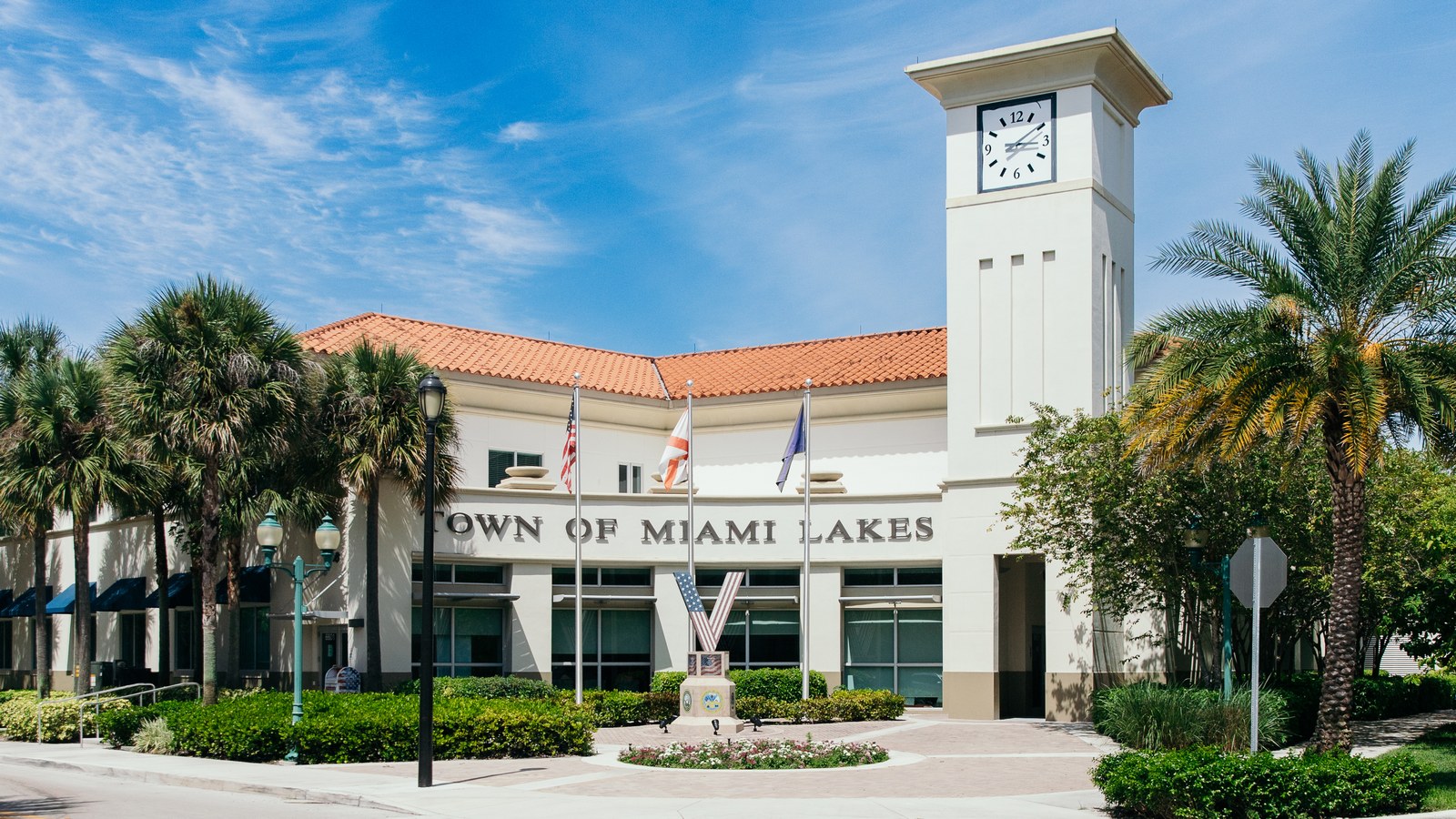
Population growth has been slow and steady rather than explosive: the town grew from 22,676 residents in 2000 to 29,361 in 2010 and 30,467 in the 2020 Census, with a median age of 43.1 — noticeably older than fast-growing neighbors like Doral — and a Hispanic/Latino population of roughly 84% (Source). Recent civic investment has focused on public space rather than new towers: the town opened a new Town Hall in April 2013 and maintains a network it says now includes 100-plus parks, tot lots and green trails, including Miami Lakes Optimist Park, Royal Oaks Park and Veterans Park (Source).
Home values in Miami Lakes
Redfin put Miami Lakes’ median home sale price at $679,550 in August 2026, down 2.9% year-over-year across all home types (Source). Zillow’s Home Value Index for the broader Miami metro area stood at $580,866 as of August 31, 2026, up 0.8% year-over-year — this is a metro-wide figure, not Miami Lakes-specific (Source). RentCafe puts average rent in Miami Lakes at $2,357 a month across all unit types, with one-bedrooms averaging $2,092 and two-bedrooms $2,510 (RentCafe didn’t list a separate studio figure) (Source).
What sets Miami Lakes apart on cost is governance as much as price. Because the Graham Companies built the town under one master plan and still owns much of its commercial land, an unusually high share of homes sit inside homeowners’ or condo associations with mandatory dues and architectural-review rules covering things like paint colors, landscaping, fencing and exterior changes (Source). On top of that, condo buildings statewide — Miami Lakes’ included — are subject to Florida’s 2022 condo-safety reforms, including the Structural Integrity Reserve Study (SIRS) requirement, which is pushing reserve funding, and therefore fees, higher regardless of a building’s age (Source). Buyers should budget for HOA or condo dues as a real, recurring cost on top of the mortgage, and confirm what a specific association actually allows before assuming they can renovate freely.
Getting around
Walk Score gives Miami Lakes a 35 out of 100 (“Car-Dependent”), a Transit Score of 28, and a Bike Score of 38 — meaning most errands require a car, though the Main Street town center is a notable exception at a Walk Score of 75 (Source).
Miami Lakes FAQ
Is Miami Lakes walkable?
Not townwide — Walk Score rates it 35 out of 100 (“Car-Dependent”) — but the Main Street town center, built specifically to be walkable, scores a 75, making it the exception rather than the rule (Source).
Does Miami Lakes flood?
Like most of inland Miami-Dade, its main flood risk is heavy-rain and stormwater flooding rather than coastal storm surge; the town sits at a low average elevation of about 7 feet, and we couldn’t find a Miami Lakes-specific flood risk score, so check a specific address against the county’s flood zone map (Source).
What’s it like living under a Miami Lakes HOA?
Because most of the town was built by one developer under a single master plan, an unusually large share of homes belong to a homeowners’ or condo association with mandatory dues and architectural-review rules — paint colors, landscaping and exterior changes often need approval, so it’s worth reading a specific community’s covenants before buying (Source).
Do I need a car in Miami Lakes?
For most people, yes. Transit Score is 28, and Metrobus coverage is limited, though the town’s free Freebee shuttle offers weekday rush-hour service to the Palmetto Metrorail station (Source).
Is Miami Lakes good for families?
It’s one of the more established, older-skewing suburbs in the county (median age 43.1 in the 2020 Census), with over 100 parks, lakes and tot lots built into the original plan, plus M-DCPS schools — though as anywhere, confirm the zoned school for a specific address (Source).
What is there to do in Miami Lakes?
Shopping and dining along Main Street, golf and events at Shula’s Hotel & Golf Club, and sports and green space across the town’s park system, including Miami Lakes Optimist Park and the network of lakefront parks built around the original 23 lakes (Source).
Nearby alternatives*We're not ranking these — every neighborhood has real trade-offs, and which ones matter is up to you.
Doral
South — a larger, newer, more internationally-oriented planned city built around business/office parks and golf, versus Miami Lakes' smaller, older (1960s), single-Main-Street town character.
Hialeah
South — a much larger, older, denser city with a longtime Cuban-American identity, a busier urban register than Miami Lakes' quiet planned-community streets.
See what makes Miami-Fort Lauderdale stand out — verified, named medical, dietary, sports, and other specialty resources you won't find in most metros.
Explore Specialty Resources →