Edgewater, Miami, FL

What Edgewater is actually like
Edgewater took shape in the early 1900s as a strip of “fine single-family homes and small apartment buildings” squeezed between Biscayne Bay and the Florida East Coast Railway, platted piecemeal by a handful of small subdivisions that left it with an irregular street grid it still has today (CondoBlackBook). Biscayne Boulevard itself was a 1920s project: the Shoreland Company started building it as a four-lane showcase boulevard linking Miami to Miami Shores, then went bankrupt after the catastrophic 1926 hurricane, and the Biscayne Boulevard Company picked up the project and finished it, eventually anchored by three department stores — Sears, Burdine’s, and Jordan Marsh (CondoBlackBook).
By the postwar decades Edgewater had filled in with modernist office and apartment towers, including the Bacardi Building, a MiMo landmark on Biscayne Boulevard, while upscale residential towers like the Charter Club and Bay Park Towers pulled affluent residents back from the suburbs (CondoBlackBook). The 1973 Omni complex, part of the larger Plaza Venetia megaproject, anchored the neighborhood’s south end with a mall, hotels, and housing, and cruise-line pioneer Ted Arison built the Hamilton condominium nearby, shaped — deliberately — like a cruise ship gliding into the bay (CondoBlackBook).
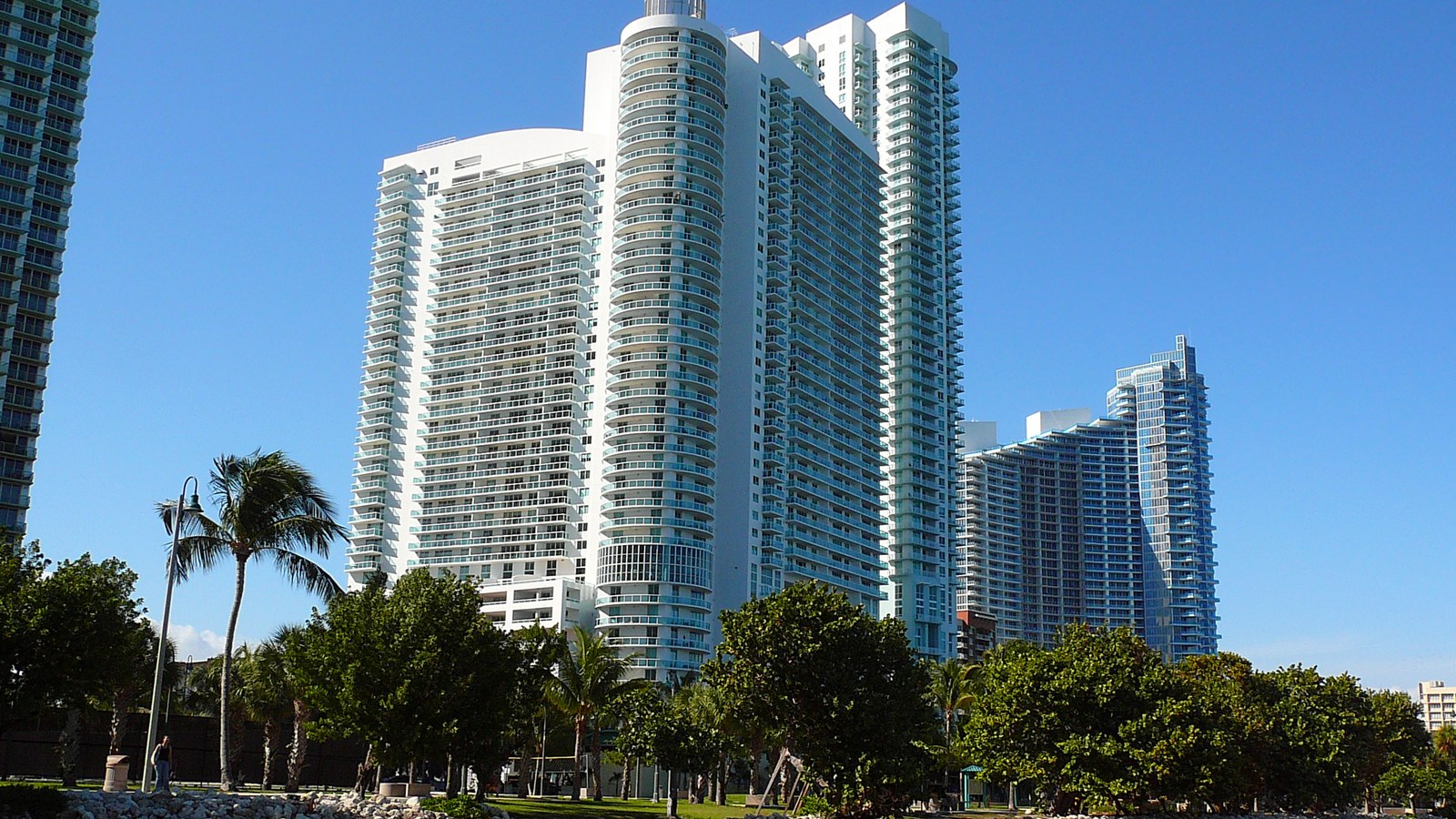
The real transformation is the post-2000 condo boom, which accelerated further after about 2010 as developers began assembling the long-overlooked bayfront parcels that had sat as low-rise or vacant lots for decades into towers like Paramount Bay, Quantum on the Bay, Icon Bay, Paraiso, Aria on the Bay, Biscayne Beach, Elysee, and Missoni Baia (CondoBlackBook; Million Luxury). That boom is still running: as of 2026, at least nine more towers are in preconstruction or under construction along the bay, including Aria Reserve, EDITION Edgewater, and Villa Miami (CondoBlackBook). The neighborhood’s population more than doubled in a decade — Census figures put it at 14,819 in 2000 and 21,826 in 2010, up 47.3% (Wikipedia) — though a separate tally puts the 2010 figure closer to 15,005, likely reflecting a different boundary definition after the mid-2000s branding of neighboring Midtown Miami carved off part of what used to be considered Edgewater’s territory (Wikipedia).
Home values in Edgewater
Edgewater is a small, condo-heavy, low-transaction-volume market, and Redfin’s numbers show it: over the three months in its most recent report, the median sale price was $740,000, down 20.4% versus the same period a year earlier, with a median price per square foot of $623 (down 25.9%) across 43 homes sold and a typical 154 days on market — a swing that likely reflects the small sample size and a shifting mix of closings as much as any real repricing (Redfin). Zoomed out to the whole metro, Zillow’s Home Value Index for the Miami metro area was $580,866 as of August 31, 2026, up 0.8% year-over-year (Zillow). RentCafe groups the area as “Midtown – Edgewater” and lists it among Miami’s most expensive neighborhoods to rent, at an average of $3,442 a month; a studio/one-bedroom/two-bedroom breakdown specific to Edgewater wasn’t available this pass, though citywide Miami averages run roughly $2,265 for a studio, $2,450 for a one-bedroom, and $2,995 for a two-bedroom for rough context (RentCafe). Edgewater’s housing stock is overwhelmingly high-rise condo — local brokers describe it as “dense urban, mostly renters” and dominated by luxury bayfront towers (Marcelo Steinmander) — so Florida’s post-Surfside condo law, SB 4-D, applies to essentially the whole neighborhood: buildings three stories or taller must complete a milestone structural inspection at 30 years old (25 years within three miles of the coast, which covers all of bayfront Edgewater) and maintain a fully funded structural integrity reserve study rather than waiving reserves the way many older associations once did (Florida DBPR). Expect HOA dues on Edgewater towers to run higher than a comparable single-family budget, and ask for a building’s reserve study and any pending special assessments before making an offer.
Getting around
Sources disagree somewhat on Edgewater’s exact Walk Score — a neighborhood guide reports 80 out of 100 (“Very Walkable”) (Homes.com), while a SoFi market report citing Walk Score data puts it higher, at 95 (SoFi); neither figure was cross-checked directly against walkscore.com this pass. Both sources agree Edgewater’s Transit Score is around 48 out of 100 (“Some Transit”), consistent with a bus-and-trolley neighborhood with no rail station of its own (Marcelo Steinmander; SoFi).
Edgewater FAQ
Is Edgewater, Miami walkable?
Reports vary — one neighborhood guide puts its Walk Score at 80 (“Very Walkable”) and another market report puts it at 95, and neither was independently verified against walkscore.com this pass, but both describe a genuinely pedestrian-friendly bayfront strip with Margaret Pace Park and the Baywalk (Homes.com; SoFi).
Does Edgewater flood?
Its entire eastern edge fronts Biscayne Bay, and Redfin’s climate data puts 72% of Edgewater properties at risk of severe flooding over the next 30 years, with essentially all properties facing extreme wind risk in a hurricane (Redfin). Check a building’s elevation and FEMA flood zone before buying.
How does Florida’s SB 4-D condo law affect Edgewater?
Directly — Edgewater’s housing stock is almost entirely high-rise condo, so the post-Surfside milestone inspection and reserve-funding requirements apply to nearly every building in the neighborhood, and buyers should expect that to show up as higher HOA dues or a special assessment in older towers (Florida DBPR).
Can you live in Edgewater without a car?
It’s workable but not effortless: there’s Metrobus service and a free trolley, but no Metromover or Metrorail station in the neighborhood, and public transit to the airport takes about an hour, so many residents lean on rideshare or a car for anything beyond a short trolley hop (Compass).
Is Edgewater good for families with kids?
It’s more of a young-professional and renter-heavy condo market than a family neighborhood; the nearest zoned public schools carry C-to-B- grades, and the housing stock skews toward one- and two-bedroom high-rise units rather than family-sized homes (Homes.com).
What is there to do in Edgewater?
Margaret Pace Park and the developing Baywalk for bayfront recreation, the Bacardi Building for a look at Miami Modern architecture, and quick access to Wynwood’s galleries and Midtown’s restaurants, both just a few minutes away by car (Compass).
Nearby alternatives*We're not ranking these — every neighborhood has real trade-offs, and which ones matter is up to you.
Downtown Miami
A short trip south on Biscayne Boulevard — Miami's civic and business core, with MiamiCentral (Brightline) and more day-to-day retail/dining than Edgewater's largely residential towers.
Wynwood
Just inland to the west — a completely different feel: former warehouse district turned arts/mural/nightlife hub, lower-rise and grittier than Edgewater's bayfront condo towers, with meaningfully lower flood risk since it sits back from the bay.
See what makes Miami-Fort Lauderdale stand out — verified, named medical, dietary, sports, and other specialty resources you won't find in most metros.
Explore Specialty Resources →