Downtown Miami, Miami, FL
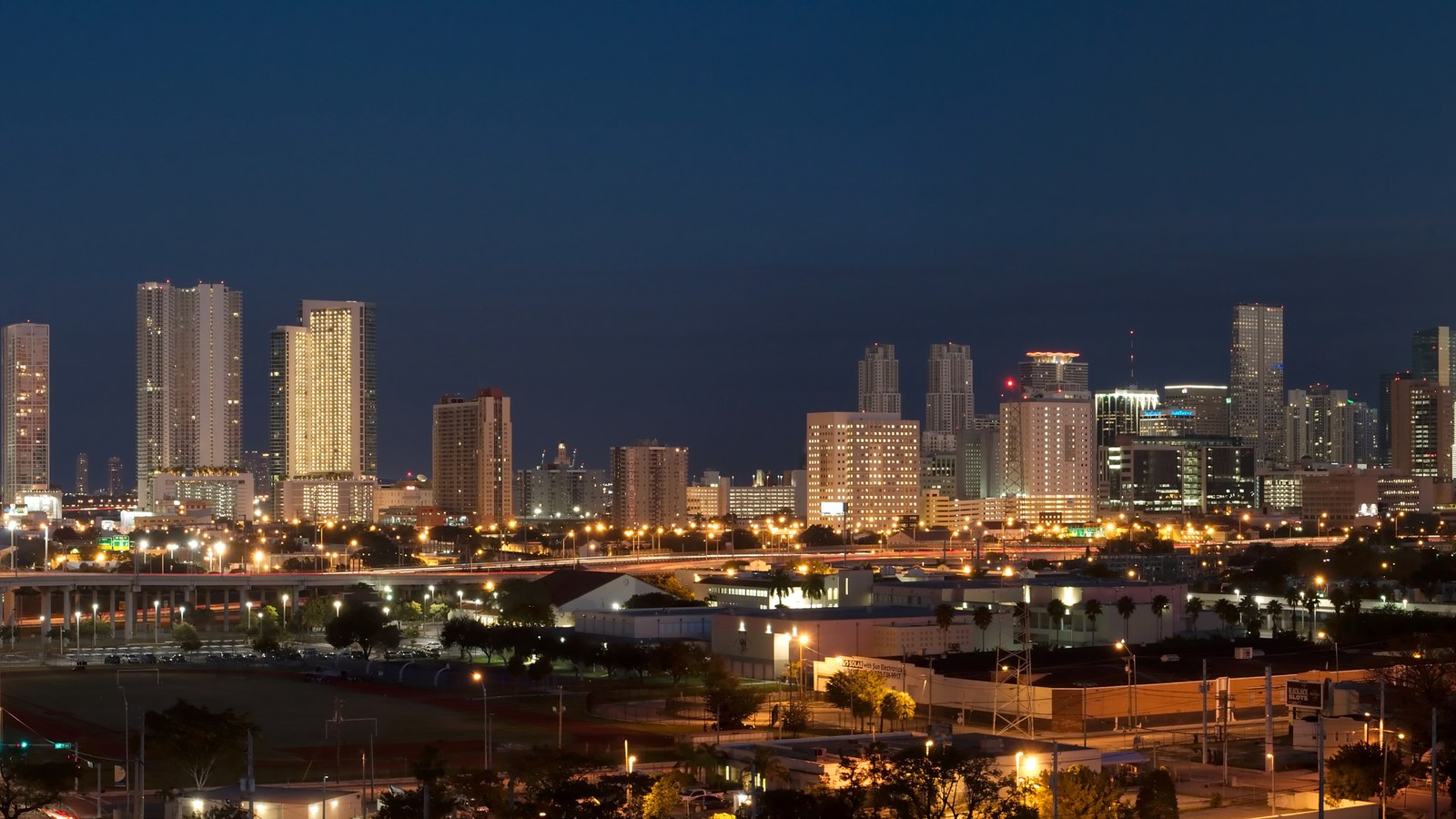

What Downtown Miami is actually like
Downtown Miami’s history starts at the mouth of the Miami River, where the 1895 Florida state census counted just nine residents (Miami and Beaches). That changed almost overnight: pioneer Julia Tuttle persuaded railroad baron Henry Flagler to extend the Florida East Coast Railway south, and when the first train arrived on April 15, 1896, it set off the growth that got Miami incorporated as a city just over three months later, on July 28, 1896, with an estimated population of 700 (Miami and Beaches; Mana Common).
The 1920s Florida land boom turned the riverside settlement into a skyline: most of the roughly 60 buildings now protected in the Downtown Miami Historic District — the Freedom Tower, the Ingraham Building, the Olympia Theater — went up between 1921 and 1926, when Miami was earning its “Magic City” nickname (Wikipedia). The 1929 crash ended that first boom hard, and by the 1970s suburban flight and urban renewal had hollowed the district out; the 1982 opening of the James L. Knight Center is usually credited with starting the long comeback, as conventions, then Latin American investment, then a new condo boom filled the skyline back in (Mana Common).
That condo boom didn’t really stop: roughly 23,628 condo and apartment units were built across Greater Downtown in the 2000s alone, and the resident population climbed from about 40,556 in 2000 to 66,769 in 2010 (up 64.6%) and 110,006 in 2020 (up another 64.8%), with an estimated 113,649 residents by 2022 — on top of a daytime population that swells past 250,000 on a workday (Wikipedia). The most visible recent addition is Brightline’s MiamiCentral station, which restored regular passenger rail service through Downtown for the first time in more than half a century (Miami and Beaches).
Home values in Downtown Miami
Redfin’s most recent monthly snapshot puts Downtown Miami’s median sale price at $630,000, up 6.7% year-over-year, with a median price per square foot of $654 (up 7.3%) — 294 homes sold in the most recent month tracked, against 400 a year earlier, and the typical listing is taking around 97 days to sell (Redfin). Zoomed out to the whole metro, Zillow’s Home Value Index for the Miami metro area was $580,866 as of August 31, 2026, up 0.8% year-over-year (Zillow). Renters see similarly big-city pricing: RentCafe puts the average Downtown Miami apartment at $3,321 a month (up 1.68% year-over-year, as of August 2026), breaking down to roughly $2,619 for a studio (485 sq ft), $3,068 for a one-bedroom (747 sq ft), and $3,748 for a two-bedroom (1,035 sq ft) (RentCafe). Because Downtown’s housing stock is overwhelmingly high-rise condo, most buyers here also need to budget for Florida’s post-Surfside condo law, SB 4-D: buildings three stories or taller must complete a “milestone” structural inspection at 30 years old (25 years if within three miles of the coast, which covers essentially all of Downtown) and keep a fully funded structural integrity reserve study, with no more waiving reserves for big-ticket items like roofing, load-bearing walls, waterproofing, plumbing, and electrical (Florida DBPR). The practical effect for buyers has been sharply higher HOA dues and the occasional large special assessment in older towers catching up on deferred maintenance; a fresh DBPR compliance snapshot specific to Downtown’s building stock wasn’t pulled this research pass, so budget for building-by-building variation and ask for a condo’s reserve study before making an offer.
Getting around
Miami-focused market data compiled by SoFi (drawing on Walk Score’s methodology) puts Downtown Miami at a Walk Score of 91 and a Transit Score of 94 — among the highest transit scores of any Miami neighborhood, reflecting the Metromover/Metrorail/Brightline convergence described above (SoFi). That figure wasn’t independently cross-checked directly against walkscore.com this pass, but it’s consistent with Downtown’s dense, transit-saturated street grid.
Downtown Miami FAQ
Is Downtown Miami walkable?
Yes — it’s one of the most walkable and transit-connected parts of the county, with a reported Walk Score around 91 and a Transit Score around 94 thanks to the free Metromover, Metrorail, and Brightline all converging here (SoFi).
Does Downtown Miami flood?
It’s a low-lying, waterfront urban core, and the data reflects that: Redfin’s climate assessment puts 93% of Downtown properties at risk of severe flooding over 30 years, with essentially all properties facing extreme wind-event risk in a hurricane (Redfin). Check FEMA’s flood maps and a building’s elevation certificate before buying.
What is SB 4-D and does it affect Downtown Miami condos?
SB 4-D is Florida’s post-Surfside condo safety law: buildings three stories or taller now need a milestone structural inspection at 30 years (25 if within three miles of the coast, which covers Downtown) and a fully funded reserve study. Since almost all of Downtown’s housing stock is high-rise condo, expect this to show up as higher HOA dues or a special assessment in older buildings (Florida DBPR).
Can you live in Downtown Miami without a car?
It’s one of the few places in Miami-Dade where that’s realistic: Metromover is free, Metrorail reaches the airport, and Brightline covers longer intercity trips, all within walking distance of most Downtown towers (Wikipedia).
Is Downtown Miami good for families with kids?
It skews toward young professionals and renters rather than families — the housing stock is almost entirely high-rise condo towers built since 2000, and a specific zoned public school for Downtown addresses wasn’t confirmed this pass, so families should check M-DCPS’s lookup tool for their exact building (GuideK12).
What is there to do in Downtown Miami?
Bayside Marketplace and Bayfront Park for waterfront shopping and events, the Adrienne Arsht Center and Kaseya Center for performing arts and Heat games, Pérez Art Museum Miami and the Frost Museum of Science on the museum park, and the historic Flagler Street corridor with the Freedom Tower and Olympia Theater for a look at 1920s Miami.
Nearby alternatives*We're not ranking these — every neighborhood has real trade-offs, and which ones matter is up to you.
Brickell
Immediately south along the Metromover loop — Miami's financial-district core, almost entirely high-rise condo towers, with a denser residential feel than Downtown's mix of government, arena, and office space.
Edgewater
The bayfront strip just north — a newer, still-booming condo corridor with less street-level retail and tourist traffic than Downtown, but the same storm-surge exposure on the bay.
See what makes Miami-Fort Lauderdale stand out — verified, named medical, dietary, sports, and other specialty resources you won't find in most metros.
Explore Specialty Resources →