Coral Gables, FL

What Coral Gables is actually like
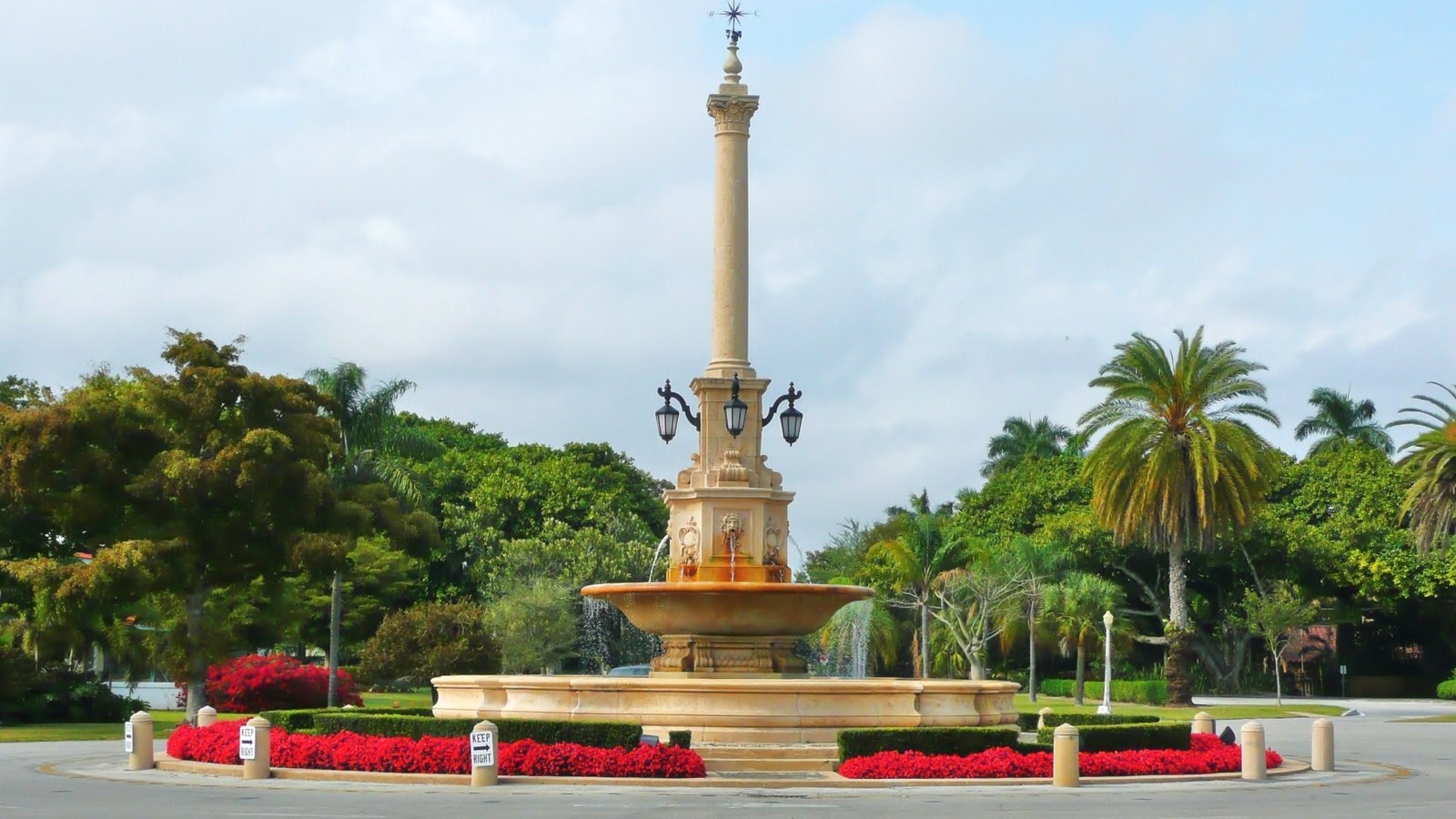
Coral Gables was not a neighborhood that grew up organically — it was platted, financed, and marketed almost entirely by one developer. George Merrick, whose family had farmed citrus on the site since 1899, began assembling architects, artists, and engineers around 1921 to lay out a Mediterranean Revival city, naming it for his family homestead’s coral-rock main house (Source). The city incorporated on April 29, 1925, and grew astonishingly fast: by October 1926 it already held more than 4,000 structures and roughly $150 million in construction, complete with grand entrance gates, plazas, and canals (Source).
The city’s defining turning point came in 1925, when the University of Miami was chartered on 240 acres west of what is now U.S. 1 — the university and the city were, in effect, founded together, and UM remains one of Coral Gables’s largest employers today (Source). Merrick also wrote his Mediterranean design vision into law: the city’s Board of Architects still reviews the exterior of essentially every building — color, materials, roofline, even paint chips from a pre-approved Benjamin Moore/Sherwin-Williams palette — making Coral Gables one of the most architecturally regulated cities in Miami-Dade County, a distinction reinforced by a 1973 historic-preservation ordinance (Source).
Coral Gables has stayed remarkably close to its founding-era population: the city counted 49,248 residents in the 2020 Census and an estimated 49,193 in 2022, with a median household income around $118,203 — well above the county average — and a Hispanic/Latino share of 58.8% (Source). Recent years have brought a wave of Class A office and luxury-condo construction around Ponce de Leon Boulevard and the Giralda Plaza dining district, reinforcing the city’s identity as one of Miami’s premier addresses for international banking, law, and insurance firms, layered on top of its century-old role as a college town built around UM (Source).
Home values in Coral Gables
The median sale price of a home in Coral Gables was $1.4M (specifically $1,399,074) over the three months ending August 2026, up 7.4% year-over-year, even as the median price per square foot slipped 5.9% to $764 — a sign the mix of homes selling has shifted toward larger properties (Source). That’s well above the broader Miami metro’s Zillow Home Value Index, which stood at $580,866 as of August 31, 2026, up 0.8% year-over-year (Source). Renters pay a premium too: RentCafe puts the average Coral Gables apartment at $4,443 a month (up 9.48% year-over-year), breaking down to roughly $2,674 for a studio, $3,275 for a one-bedroom, and $4,991 for a two-bedroom (Source).
One cost factor unique to Coral Gables: almost any exterior renovation — a repaint, new windows, a roofline change — has to clear the city’s Board of Architects, which enforces a defined Mediterranean/Spanish/Colonial design code and can require specific materials or approved colors before issuing a permit. That review adds real time and, often, real dollars to a renovation budget, and it’s one of the more distinctive — and more restrictive — zoning regimes anywhere in Miami-Dade County (Source).
Getting around
Coral Gables posts a citywide Walk Score of 56 (“Somewhat Walkable”), a Transit Score of 38, and a Bike Score of 56 — though walkability varies sharply by neighborhood, with the Crafts (93), Douglas (87), and Flagler (83) sections scoring far higher than the city average (Source).
Coral Gables FAQ
How walkable is Coral Gables?
Citywide, Coral Gables earns a Walk Score of 56 (“Somewhat Walkable”) and a Transit Score of 38, but that average hides a lot of variation — the Crafts, Douglas, and Flagler sections near Miracle Mile score in the 80s and 90s, while the leafier residential sections south and west of US-1 are much more car-dependent (Source).
Is Coral Gables at risk of flooding?
Coral Gables sits a few miles inland from Biscayne Bay, which lowers its exposure to direct storm surge compared with waterfront Miami neighborhoods, but it’s still flat, low-lying South Florida terrain crossed by canals, and the city runs its own sea-level-rise and flood-protection programs as a result (Source).
Why is home renovation more complicated in Coral Gables?
Nearly every exterior change — paint, windows, a new roofline — has to pass the city’s Board of Architects, which enforces a defined Mediterranean/Spanish/Colonial design code, sometimes down to the specific approved paint colors. It’s one of the strictest architectural review processes of any city in Miami-Dade County, and it adds real time and cost to renovation projects (Source).
Do you need a car in Coral Gables?
For most daily errands, yes — the citywide Transit Score is just 38. But the free Coral Gables Trolley and Metrorail’s Douglas Road station give car-free commuting a real foothold, especially for anyone working near Miracle Mile, UM, or downtown Miami (Source).
Is Coral Gables good for families?
It’s one of the stronger family options in the county on paper: A-rated public schools including Coral Gables Senior High and Coral Gables Preparatory Academy, the University of Miami anchoring the north side of the city, and low-density, tree-lined residential streets throughout (Source).
What is there to do in Coral Gables?
Miracle Mile and Giralda Plaza for shopping and dining, the historic Biltmore Hotel for golf and Sunday brunch, the Venetian Pool for swimming in a converted 1923 quarry, and a full slate of University of Miami sports, theater, and museum events (Source).
Nearby alternatives*We're not ranking these — every neighborhood has real trade-offs, and which ones matter is up to you.
Pinecrest
South along US-1/South Dixie Highway — another affluent, tree-canopied suburb, but a newer incorporation (1996) without Coral Gables' Mediterranean Revival architectural code and century-long planned-city history.
Doral
West across the county — a much newer planned city (incorporated 2003), built around golf and international business rather than Coral Gables' 1920s Mediterranean Revival design code.
See what makes Miami-Fort Lauderdale stand out — verified, named medical, dietary, sports, and other specialty resources you won't find in most metros.
Explore Specialty Resources →