Fountain Square, IN

What Fountain Square is actually like
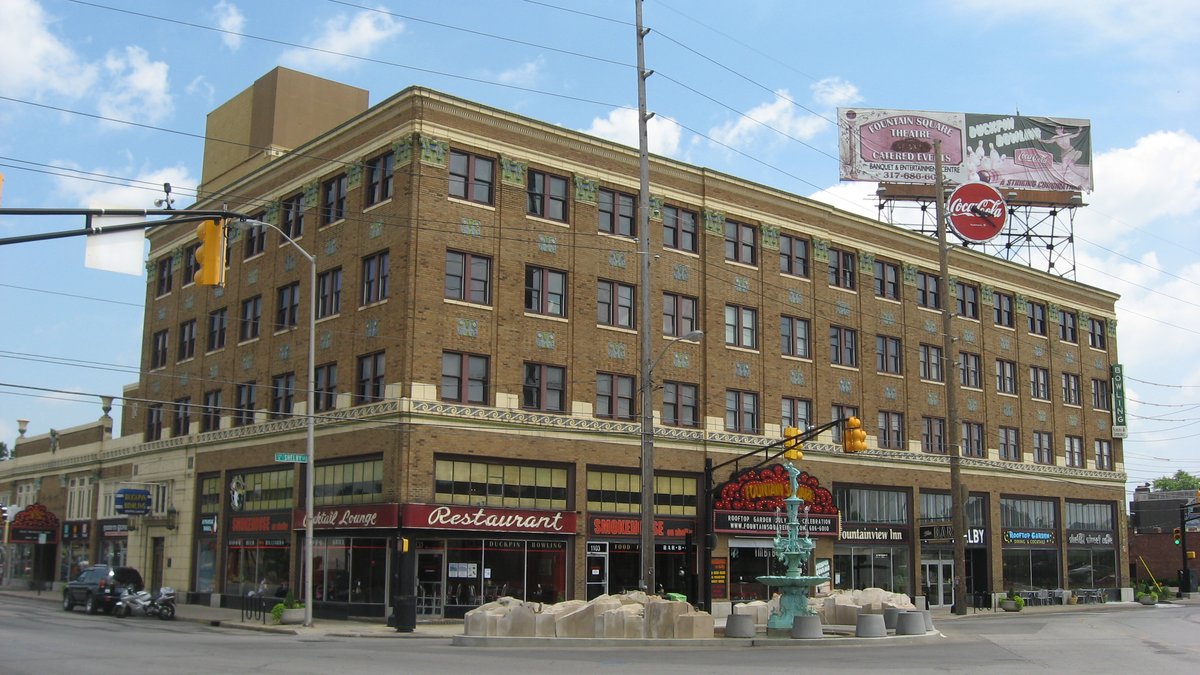
Fountain Square's land was purchased in 1835 by banker Calvin Fletcher and merchant Nicholas McCarty, who subdivided 264 acres for resale. Real growth began in 1864, when the Citizens' Street Railway Company extended mule-drawn streetcar tracks down Virginia Avenue to its intersection with Shelby and Prospect Streets -- a turnaround locals nicknamed "The End." German immigrants drove commercial development from the 1870s onward, and the neighborhood took its permanent name from a fountain merchants installed in 1889 to draw farmers stopping to water their horses. By the 1920s it was the city's first movie-theater district, with as many as seven theaters running at once, including the Fountain Square Theatre, which opened May 4, 1928.
Postwar suburbanization began the decline, and building the I-65/I-70 interchange from 1968 to 1971 razed homes and displaced more than 6,000 residents -- roughly a quarter of the neighborhood's population. Census figures show the collapse directly: population fell from 27,242 in 1950 to 19,736 in 1970, a 27.6% drop, as theaters closed and the commercial core emptied out. Historic preservation took hold in the early 1980s -- three historic districts within Fountain Square were added to the National Register of Historic Places in 1983 -- but the catalytic event most local sources point to is local barber Linton Calvert's 1993 purchase and restoration of the Fountain Square Theatre Building, into which he installed a vintage duckpin bowling alley using original 1930s equipment.
That restoration set off a broader revival: the Murphy Arts Center and Wheeler-Schebler Carburetor Company Building were both restored as arts and studio space, and new venues including White Rabbit Cabaret and Radio Radio opened alongside them. Fountain Square is now one of Indianapolis's most walkable, bikeable neighborhoods and a genuine draw for the city's arts and nightlife scene -- though its Wikipedia-cited home values from the 2000-2013 era ($47,000 to $81,000 average) are more than a decade stale, and a current, live figure should be pulled before quoting a specific number.
Home values in Fountain Square
We couldn't confirm a current, live home-value figure for Fountain Square specifically in our research — rather than publish a stale or citywide number that might not reflect this specific part of town, we're leaving pricing out of this particular guide for now.
See what makes Indianapolis stand out — verified, named medical, dietary, sports, and other specialty resources you won't find in most metros.
Explore Specialty Resources →Fountain Square FAQ
How did Fountain Square get its name?
From a fountain merchants installed in 1889 at the Virginia Avenue/Shelby/Prospect Street intersection to draw farmers watering their horses; the current fountain, "The Pioneer Family" by sculptor Myra Reynolds Richards, was dedicated in 1924.
What caused Fountain Square's mid-20th-century decline?
Construction of the I-65/I-70 interstate interchange from 1968 to 1971 displaced more than 6,000 residents -- about a quarter of the neighborhood's population -- contributing to a population drop from 27,242 in 1950 to 19,736 in 1970.
What kicked off the neighborhood's revival?
Local barber Linton Calvert's 1993 purchase and restoration of the Fountain Square Theatre Building, into which he installed a vintage duckpin bowling alley using original 1930s equipment -- still billed as one of the only traditional duckpin alleys in the Midwest.
Is Fountain Square walkable and transit-friendly?
Yes -- it has its own IndyGo Red Line bus rapid transit station (opened 2019) and direct access to the 8-mile Indianapolis Cultural Trail.
Does Fountain Square flood?
Its core intersections (Virginia Avenue, Prospect Street, Shelby Street, Morris Street) have had recurring stormwater flooding documented since 2015, which is why the city is building a new Shelby Street storm sewer trunk line in phases through 2032.