Downtown Indianapolis, IN
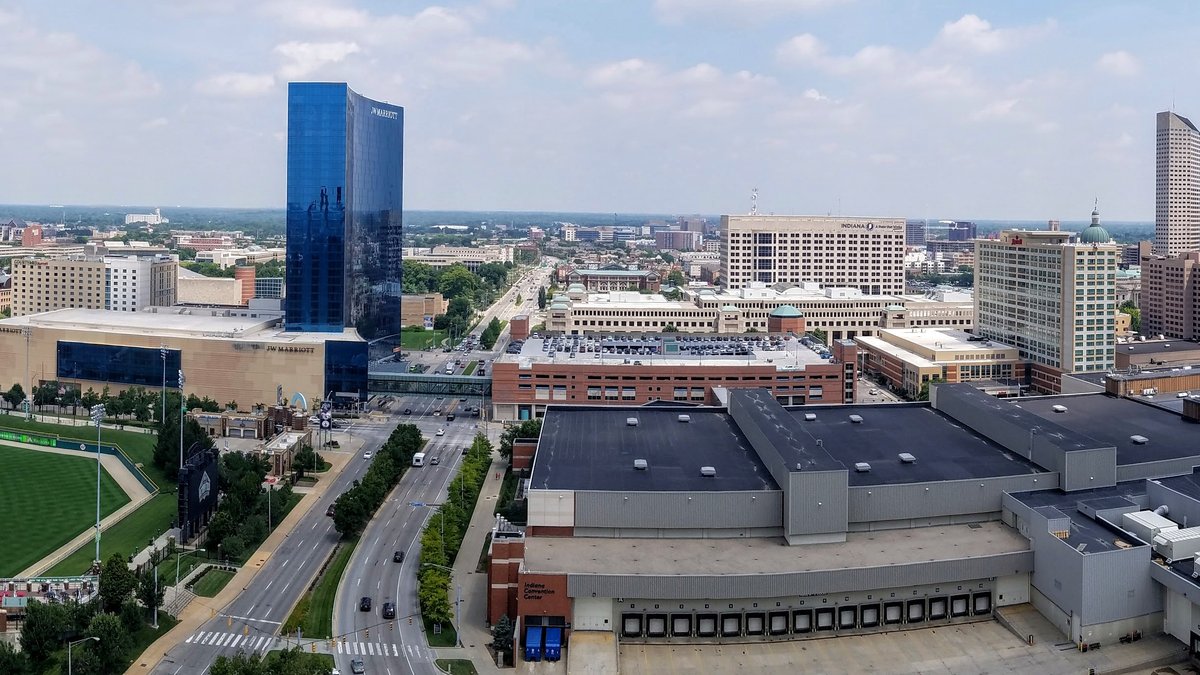

What Downtown Indianapolis is actually like
Indianapolis was chosen as Indiana's state capital in 1820, and surveyor Alexander Ralston -- who had worked under Pierre L'Enfant on the plan for Washington, D.C. -- platted the town in 1821 as a one-square-mile grid bounded by North, East, South, and West Streets, centered on a circular commons that's now Monument Circle, with diagonal state-named avenues radiating outward. That grid, with one irregularity where Pogue's Run once cut diagonally through the southeast corner, is still the literal shape of downtown today.
The city grew fast around it -- from 8,091 residents in 1850 to 169,164 by 1900 -- producing landmark buildings like the Soldiers' and Sailors' Monument and the Indiana Statehouse. Downtown then followed the familiar national arc: postwar suburbanization and decline, followed by 1960s and 1970s urban renewal and interstate construction that displaced Black residents, particularly around Indiana Avenue. A sports-driven revival took hold in the 1980s (roughly $122 million invested) and a building boom from 1982 to 1990 produced six of the city's ten tallest buildings; Downtown Indy, Inc., the nonprofit that still champions downtown today, was founded in 1993.
The turnaround has kept compounding. Downtown's residential population -- what the city calls the "Regional Center" -- grew from 14,664 in 2010 to 22,412 in 2020 to 30,467 in 2025, with families living downtown up roughly 70% since 2010 and a median resident age of just 31.5. 2024 and 2025 brought the Kimpton Hotel's office-to-hotel conversion, Elanco's headquarters expansion, the $600 million Circle Centre Mall redevelopment, and office-to-apartment conversions at the Gold Building and the Angie's List Building -- downtown is being built for people who live there now, not just people who work there.
Home values in Downtown Indianapolis
Redfin puts the median sale price for Downtown Indianapolis at $389,867 for the three months ending around July 2026, down 2.8% year-over-year. We couldn't pull a live Zillow figure for downtown specifically -- its Zillow page returned repeated rate-limit errors during research -- so treat Redfin's figure as the more current source here.
See what makes Indianapolis stand out — verified, named medical, dietary, sports, and other specialty resources you won't find in most metros.
Explore Specialty Resources →Downtown Indianapolis FAQ
Is downtown Indianapolis walkable?
Yes, relative to the rest of the city -- 84% of downtown residents in a 2025 survey said it's easy to get around on foot, even though Indianapolis overall has a low citywide Walk Score of 31. Downtown's own compact, Ralston-platted grid is the main reason why.
Does downtown Indianapolis flood?
Not on the scale it used to. The March 1913 flood remains Indiana's worst on record, and Pogue's Run, which flooded the Mile Square's southeast corner as recently as 1882, was buried in a culvert in 1914-15 and now runs underground beneath Lucas Oil Stadium and Gainbridge Fieldhouse. Levee work since 1913 has held, though central Indiana saw major regional flooding again in August 2026 -- always check FEMA flood maps for a specific address.
What bus or rail transit serves downtown?
The Red Line (since 2019) and Purple Line (since October 2024) bus-rapid-transit routes both run through downtown and hub at the Julia M. Carson Transit Center; a third line, the Blue Line, broke ground in March 2025 for a targeted 2028 opening.
Which school district serves downtown?
Indianapolis Public Schools (IPS), though most children living within IPS boundaries -- 61% as of 2025 -- actually attend independently run charter or IPS-innovation schools rather than traditional district-operated ones. Confirm the specific option for an address through Enroll Indy.
Is downtown's population actually growing, or is it still mostly offices?
It's genuinely growing -- downtown's residential population rose from 14,664 in 2010 to 22,412 in 2020 to 30,467 in 2025, with families living downtown up about 70% since 2010, alongside its long-standing role as the civic and sports core of the city.