Downtown Raleigh, NC
.jpg)
What Downtown Raleigh is actually like
Downtown Raleigh's modern shape owes the most to two overlapping shifts: a post-pandemic move away from an office-centric economy toward a residential and tourism-driven one, and a wave of adaptive-reuse and new-construction development that has followed it. The Dillon, an adaptive reuse of the 1914 Dillon Supply Co. warehouse at 401 W. Hargett St. in the Warehouse District, kept the original building's industrial detailing while converting it to offices and retail. A few blocks north, Smoky Hollow -- a multi-phase mixed-use district built by Kane Realty Corp and Williams Realty at downtown's northern gateway near Glenwood South -- has added the Peace Raleigh Apartments and The Line apartments alongside a Publix anchor, with a future Phase 3 zoned for buildings as tall as 40 stories.
That growth is not abstract: downtown's population has roughly doubled in just over a decade, more than 5,000 residential units have been added since 2020, and the Downtown Raleigh Alliance's 2026 "State of Downtown Raleigh" report counted 2,899 residential units under construction and more than $7.1 billion invested, with rental vacancy running low at around 8%. The same report also named a "perception gap" worth stating plainly rather than glossing over: crime is reportedly down overall, but a small number of high-profile incidents -- a drug bust near Moore Square and a July 2026 "teen takeover" incident among them -- have hurt downtown's public image even as the underlying numbers move the other way.
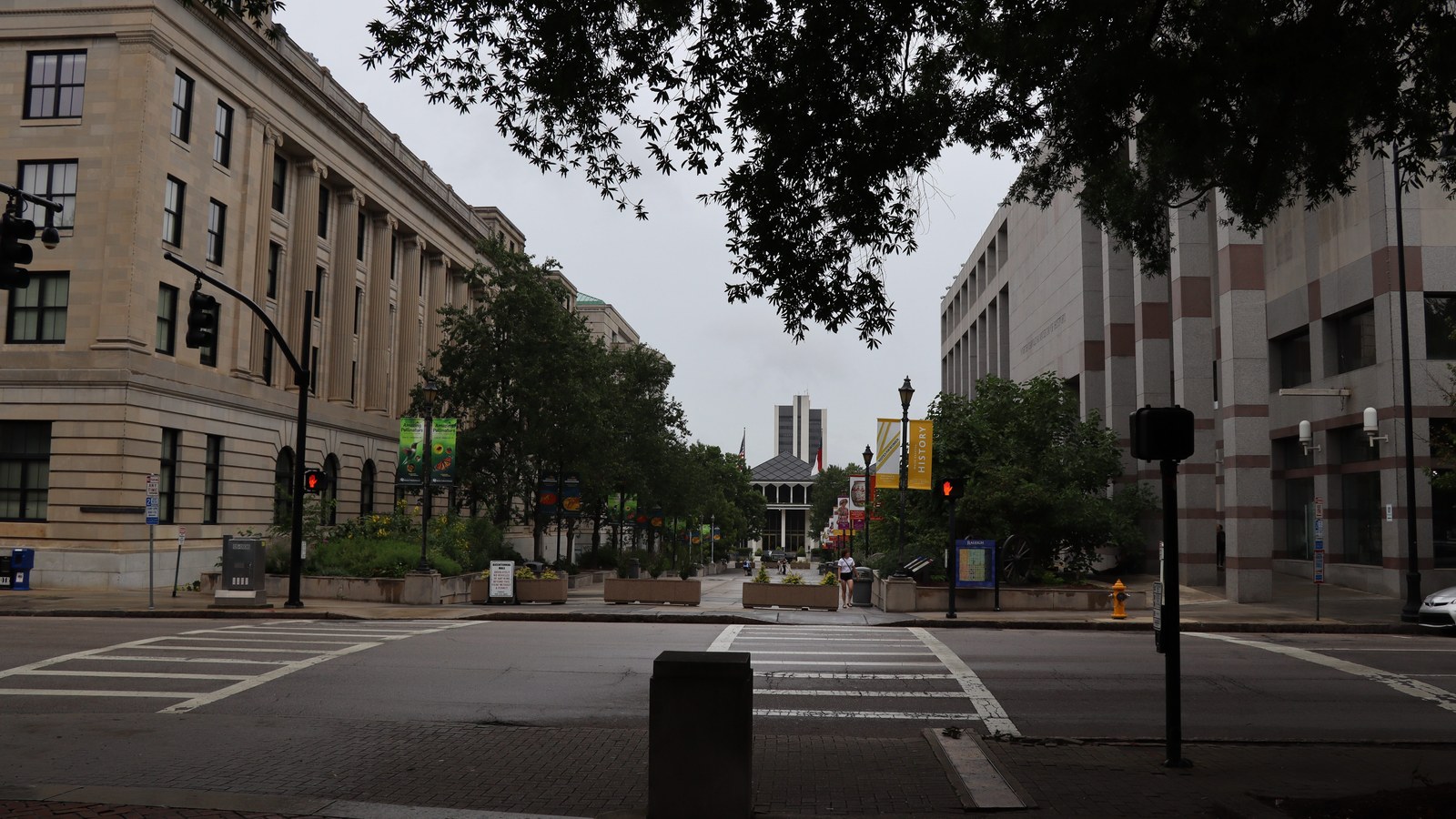
What actually draws people downtown today is concentrated in a few places: Fayetteville Street's restaurant and bar core, Glenwood South's nightlife strip and luxury condo towers, the redesigned public park at Moore Square, the NC State Capitol and its surrounding museums, and increasingly Dorothea Dix Park, a 308-acre former state hospital campus at downtown's southern edge being converted into a major urban park.
Home values in Downtown Raleigh
Redfin's 3-month trailing median sale price for Downtown Raleigh was $472,272 as of August 2026, down 14.8% year-over-year, with a median of $402 per square foot (up 8.9% year-over-year) (Redfin). That runs modestly above Zillow's ZHVI for the Raleigh metro overall, $435,237 as of July 31, 2026 and down 2.0% year-over-year (Zillow) -- downtown's smaller, denser, more vertical/condo-heavy submarket is seeing a sharper price decline than the metro as a whole, likely reflecting the wave of new supply described above. RentCafe puts downtown's average rent at $1,912 (836 sq ft) as of August 31, 2026 -- a studio averages $1,395 (550 sq ft), a one-bedroom $1,749 (727 sq ft), and a two-bedroom $2,409 (1,151 sq ft), roughly in line with the citywide Raleigh average (RentCafe).
Getting around
Downtown Raleigh itself is genuinely walkable and bikeable — a Walk Score around 88 ("Very Walkable"), Bike Score around 91 ("Biker's Paradise"), and Transit Score around 73 ("Excellent Transit") for the core, backed by GoRaleigh's bus network, Cardinal Bikeshare, and Raleigh Union Station's Amtrak service (Walk Score). That drops off fast once you leave downtown: Raleigh's citywide Walk Score is only around 31, reflecting how car-dependent the broader metro is, so day trips outside the core generally need a car, rideshare, or a GoTriangle regional bus. There's no subway or light rail anywhere in the Triangle -- the Wake BRT New Bern Avenue line, under construction as of September 2026 with no confirmed opening date, will be the first of its kind here once it opens.
Downtown Raleigh FAQ
Is there a subway or light rail in downtown Raleigh?
No -- there's no light rail, subway, or commuter rail anywhere in Raleigh or the Triangle. Downtown does have GoRaleigh city buses, GoTriangle regional buses, and an Amtrak stop at Raleigh Union Station, and a bus rapid transit line to WakeMed is under construction, but none of that is rail.
Can I get by without a car living downtown?
It's realistic to try within downtown itself -- Walk Score around 88, Bike Score around 91, plus Cardinal Bikeshare -- but the broader metro is car-dependent (Raleigh's citywide Walk Score is only around 31), so day trips outside downtown usually mean a car, rideshare, or a GoTriangle bus.
Does downtown Raleigh flood?
Not from hurricanes or storm surge -- Raleigh sits roughly 150 miles inland. The real risk is flash flooding from urban creeks; Pigeon House Branch actually rises inside downtown itself, and Smoky Hollow flooded during an intense rain event in August 2025. The city's own stormwater FAQ admits FEMA maps don't capture every flood-prone spot.
What's the nearest hospital?
WakeMed Raleigh Campus is closest, a few miles east of downtown along New Bern Ave. UNC Rex and Duke Raleigh are both roughly 4-5 miles out in the other direction -- three major hospital systems within a short drive of downtown.
Is downtown Raleigh good for families with kids?
It's not really the target buyer today -- the area skews young and small-household, and there's no traditional zoned elementary or high school inside the core itself, just Ligon Middle School (a WCPSS magnet) and The Exploris School (a K-8 charter). Families set on a specific WCPSS school should look at the surrounding neighborhoods.
Is downtown Raleigh growing?
Fast -- the population has roughly doubled over the past decade, more than 5,000 residential units have been added since 2020, and about 2,900 more are currently under construction. Prices have recently softened as that new supply comes online: the median sale price was down roughly 15% year-over-year as of August 2026.
What's a must-know building or place downtown?
The Dillon (an adaptive reuse of a 1914 warehouse), Smoky Hollow (the mixed-use district at downtown's northern gateway), and Dorothea Dix Park (a 308-acre former state hospital campus becoming a major urban park) are the three most-cited transformation stories downtown.
Nearby alternatives*We're not ranking these — every neighborhood has real trade-offs, and which ones matter is up to you.
North Hills
About 5 miles north via Six Forks Road/I-440, with a GoRaleigh bus connecting the two directly. North Hills' $854,703 median sale price runs well above downtown's $472,272, trading downtown's mix of new towers and adaptive-reuse warehouses for North Hills' newer mixed-use retail-and-apartment core.
Five Points
An estimated 2.5-3 miles north, with Five Points' $994,654 median sale price running well above downtown's $472,272 — Five Points trades downtown's high-rise density for a century-old single-family bungalow neighborhood.
Oakwood
A few blocks east of the State Capitol, the closest of any place in this sub-region — Oakwood's $965,000 median sale price runs well above downtown's $472,272, trading downtown's new-construction towers for a protected district of 19th-century Victorian homes.
See what makes Raleigh-Durham stand out — verified, named medical, dietary, sports, and other specialty resources you won't find in most metros.
Explore Specialty Resources →