Irving, TX
What Irving is actually like
Irving was platted in 1903 when J.O. "Otto" Schulze and Otis L. Brown bought 80 acres from a local rancher and named the townsite for author Washington Irving, reportedly a favorite of Brown's wife; it incorporated in 1914 with Brown as first mayor. For its first four decades Irving stayed a small farm town of a few hundred people growing fruit and vegetables on "truck farms," then exploded after 1950 — 2,615 residents that year, 45,895 by 1960, over 100,000 by 1970 — as postwar industry and the University of Dallas (founded 1956) pulled in growth. Texas Stadium opened in Irving in 1971 and was the Dallas Cowboys' home through 2008 (it was demolished in 2010, so don't expect to find it standing); that 37-year run put Irving's name in front of a national audience the city has never quite lost.
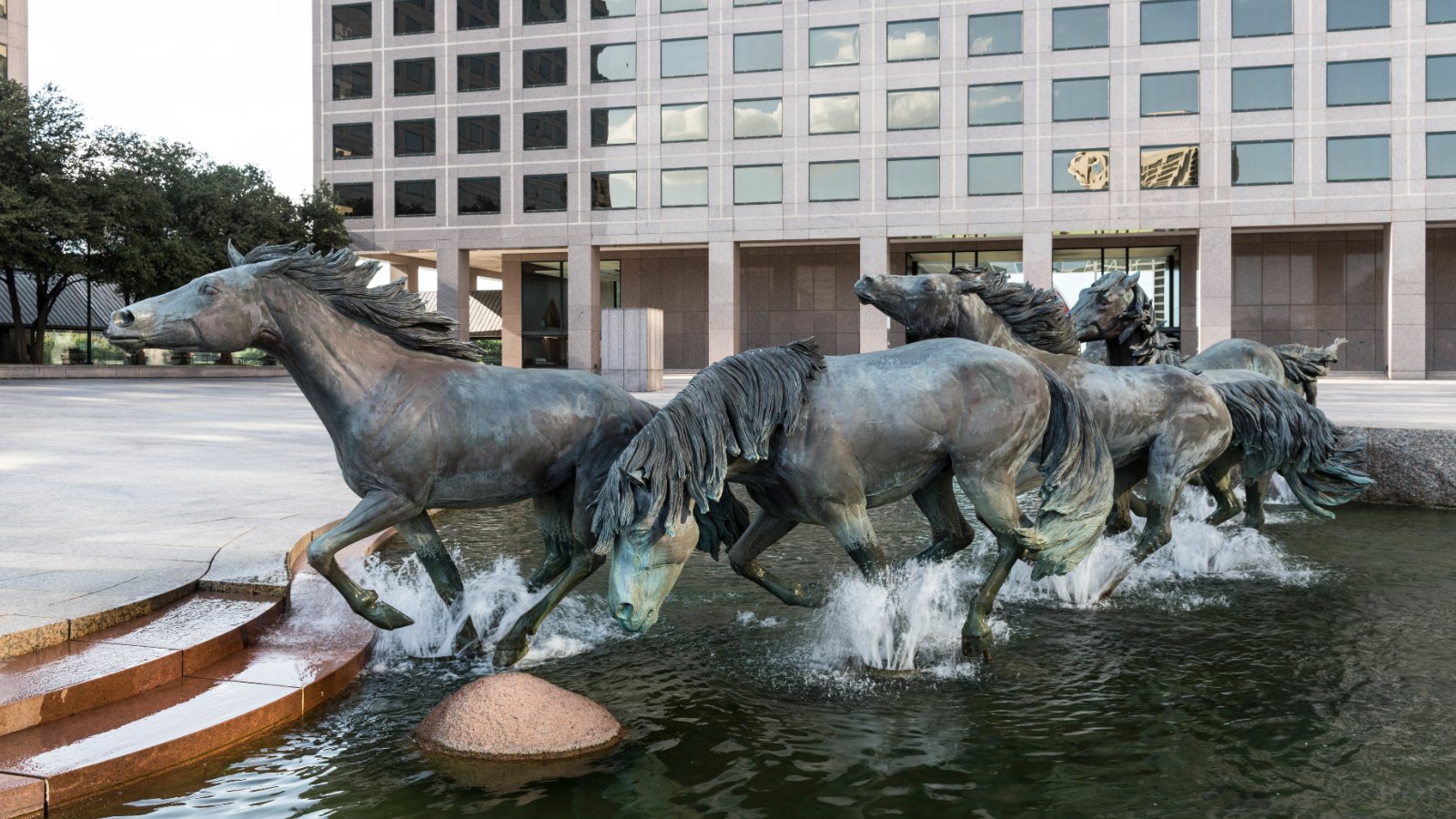
Today Irving's defining feature is Las Colinas, a 12,000-plus-acre master-planned business district that developer Ben Carpenter began building in 1972 on former ranch land — office towers, canals with reservable gondola rides on Mandalay Canal, an automated people-mover, and both high-rise and single-family residential enclaves. It's genuinely a corporate-headquarters city: Caterpillar moved its global HQ to Las Colinas in 2022, and Fluor, Kimberly-Clark, Celanese, Commercial Metals, Vistra, McKesson, Nexstar Media Group, and 7-Eleven are all headquartered here too, alongside large employer campuses (not headquarters) for Citigroup, Allstate, and Verizon. Part of DFW Airport's own footprint sits inside Irving's city limits, on the northeast corner. Census figures put Irving among the most diverse cities in the country by population mix — no single racial or ethnic group is a majority, over 40% of residents are foreign-born, and housing splits between Las Colinas high-rises/canal-front towers and older, smaller-lot mid-century neighborhoods in central and south Irving.
Home values in Irving
The typical home value in Irving currently runs $339,198, per Zillow — down 0.3% year-over-year as of August 2026.
Getting around
DART's Orange Line runs six stations through Irving — Belt Line, Dallas College North Lake Campus, Hidden Ridge, Irving Convention Center, Las Colinas Urban Center, and University of Dallas — continuing on to DFW Airport Terminal A in one direction and downtown Dallas in the other. The Trinity Railway Express also stops at Downtown Irving/Heritage Crossing and West Irving on its way between Dallas Union Station and downtown Fort Worth.
Irving FAQ
Is Irving basically part of Dallas?
No — Irving is its own separately incorporated city in Dallas County, immediately west of Dallas, with its own government, school district, and tax base. It just happens to share a border and, unusually, part of DFW Airport's own land.
Is ExxonMobil still headquartered in Irving?
No — that's a common outdated claim. ExxonMobil was headquartered in Irving for decades but moved its headquarters to Spring, TX (north of Houston) in 2015-16. Irving's genuine current Fortune 500/1000 headquarters include Caterpillar, Fluor, Kimberly-Clark, Celanese, Commercial Metals, Vistra, and McKesson.
What happened to Texas Stadium?
The Dallas Cowboys played there from 1971 to 2008, then moved to what's now AT&T Stadium in Arlington, a different city. Texas Stadium itself was demolished in 2010 — the site is a historical footnote now, not a structure you can visit.
Does Irving really have canals and gondolas?
Yes — Las Colinas's Mandalay Canal offers reservable Venetian-style gondola rides, and the area also has its own automated people-mover system, both unusual features for a Texas suburb.
Nearby alternatives*We're not ranking these — every neighborhood has real trade-offs, and which ones matter is up to you.
Grand Prairie
About 10 miles south of Irving. Zillow puts Grand Prairie's typical home value at $317,295, somewhat below Irving's $339,198, with a comparable commute distance into Downtown Dallas.
See what makes Dallas-Fort Worth stand out — verified, named medical, dietary, sports, and other specialty resources you won't find in most metros.
Explore Specialty Resources →